How to Interpret Land Use and Green Space Maps in the Relocheck Location Report
How to read land-use, green-space, and soil-sealing maps in the Relocheck location report and turn them into clear location decisions.
12.03.2026
Why Land Use and Green Space Are Real Location Factors and Not Just Nice to Have
When searching for property, green space is often reduced to the question of whether there is a park nearby. In reality, it includes a whole bundle of everyday effects: outdoor quality of stay, play and movement areas for children, short routes for walks, and also urban climate aspects such as cooling, air quality, and heat exposure. At the same time, land use in the neighborhood, whether residential, commercial, industrial, agricultural, water-related, or mixed, is a strong indicator of how an area actually functions. Is it mainly a residential environment, a mixed-use area, or strongly dominated by commerce and traffic? Relocheck makes these aspects systematically comparable in the location report by combining several visualizations instead of offering just one statement: a land-use map showing which uses dominate, a green-space map showing density and distribution of vegetation, a soil-sealing map showing how strongly surfaces are covered by impermeable materials such as asphalt and concrete, and distance indicators such as the minimum distance to the next green area or to areas with low soil sealing. Together these form an objective location profile that can be compared across several properties using the same criteria. For families, this means play and recreation quality become measurable instead of gut feeling. For renters, recovery, daily routes, and perceived burden such as heat or urban intensity become easier to plan. For buyers and investors, the neighborhood profile becomes transparent as a demand factor, because locations with good access to green space and a balanced land-use mix are often more resilient to changes in preferences. For agents and professionals, this creates a clear, data-based language for explaining location differences without resorting to subjective judgments.
The Land-Use Map: What It Shows and How to Derive Neighborhood Character from It
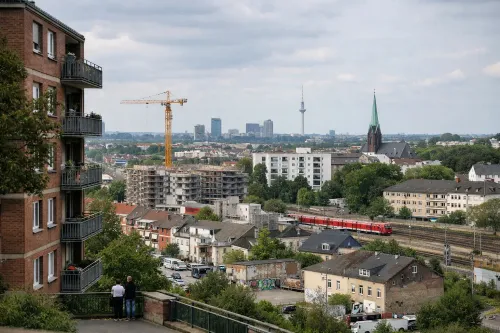
The land-use map in the report categorizes areas by the activities taking place there, for example residential, commercial, agricultural, or industrial use. That may sound abstract, but in property decisions it is extremely practical because it provides an objective answer to the question: which use shapes my surroundings, and what does that mean for everyday life and future development? To read the land-use map from a location-decision perspective, start by recognizing use dominance. The report typically shows shares in percent for each land-use class. That matters because the question is not about individual plots but about the overall profile of the surroundings. A high share of urban fabric points toward residential or mixed structures, while a significant share of industrial or commercial use can indicate stronger traffic frequency, delivery traffic, or a more functional environment. It is also important to understand the class discontinuous urban fabric. This class describes urban structures and traffic networks in combination with vegetated areas and open surfaces in a discontinuous spatial pattern. A key addition in the report is that impermeable features such as buildings, roads, and paved areas typically lie within a defined range of land cover. For interpretation, that means it is not pure dense inner-city hardness, but often a mixed urban fabric with greenery and open surfaces, often typical of livable city areas, though not automatically quiet. Agricultural and natural classes should not be romanticized either. Complex cultivation patterns, pastures, or water bodies can positively influence recreation and climate, but depending on the exact location they can also imply restrictions such as seasonal use, path structure, or distances. The map helps you read that realistically rather than simply calling it green. Commercial and industrial classes should also be assessed soberly. The report describes industrial or commercial units as areas dominated by buildings, built structures, and artificial surfaces such as concrete and asphalt, sometimes with some vegetation. For buyers and renters this is not automatically negative, but it is a clear sign that daily life may include traffic peaks, logistics, or a more functional environment. The great advantage of the land-use map is that it makes neighborhood character comparable. Two properties may both be described as near the city, yet one lies in a residential urban fabric with green elements while the other sits in an environment with a higher commercial or industrial share. Those are different living realities, and the map makes them transparent.
- ✓ Read land use as context: which one or two classes dominate? That is the basic profile of the location.
- ✓ If there is a noticeable commercial or industrial share, pay special attention to traffic corridors, delivery zones, and daily rhythm, weekday versus weekend.
The Green-Space Map: How to Read Density, Distribution, and the Biodiversity Logic Correctly
In the report, green space is not viewed simply as whether a park exists, but as a spatial density distribution. The green-space map shows the density of vegetated areas across a region and represents their distribution on a green color scale. This matters because it makes differences visible that property listings rarely show honestly. A home can be close to a park and still sit in an otherwise heavily sealed and green-poor street environment. Or it can lie in a broadly green setting with many smaller green elements throughout the area. To interpret the green color scale for decisions, start by thinking in density instead of isolated points. A single green space may be nearby, but everyday life is often shaped by the green profile of the routes: how green is the way to school, to the supermarket, or to public transport? High density over larger areas points to a more green neighborhood. Low density means green is only occasional or largely absent. Distribution also matters for usability. For families, it makes a difference whether greenery is concentrated in a few large parks or whether there are many smaller green areas close by, such as a nearby playground or short spontaneous outdoor breaks. For working adults or people in home office, the question is whether there is real recreational green space within five to ten minutes on foot, or only decorative roadside greenery. More green is also not automatically more sun. The report explicitly notes that very high tree cover in the immediate vicinity can create problematic shading. This is a typical trade-off zone: green space improves climate and quality of stay, but depending on location and tree height it can also reduce daylight or shade balconies. Anyone who prioritizes sunlight should therefore think about the green-space map together with daylight and shadow analyses. Green space also acts as a climate and comfort indicator. The report points out that the amount of green area can influence how attractive the surroundings feel. In practice, that means greenery often acts as a buffer against heat islands and improves outdoor usability, a factor that becomes increasingly relevant during hot summers. The green-space map is therefore a powerful comparison tool because it provides a visual, standardized answer to the question: how green is my environment really, and how is that greenery distributed?
- ✓ Read the green-space map as a density map: not just park yes or no, but how green is the environment overall?
- ✓ If tree cover is very high near the property, check specifically for possible shading of the apartment or outdoor areas.
Distance Indicator: Minimum Distance to the Nearest Green Area, What It Does and Where It Needs Context
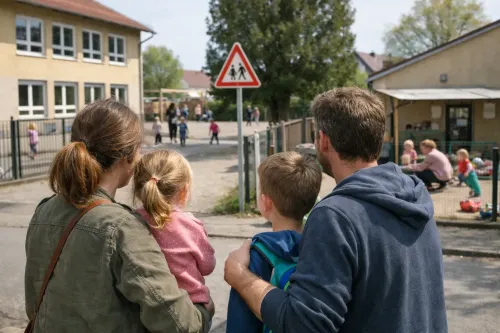
Besides the green-space map, the report also uses a distance indicator: the minimum distance to the nearest green area. Its benefit is immediate because it brings a clear comparable number into the decision process, making it especially useful in the shortlist phase. In practical interpretation, for families a shorter distance means a higher probability that green space is truly usable in everyday life, whether for getting outside quickly, walking with a stroller, or spontaneous play and movement. For renters and working adults, a short distance lowers the threshold for daily recovery and can be a real quality-of-life factor in dense locations. For buyers and investors, proximity to parks and green areas can be a robust demand argument because it is difficult to build this feature into a location afterward and it remains attractive for many target groups. However, the technical limitation is important: distance says nothing about quality, size, accessibility, or barriers. A park 300 meters away may be separated by a major road. A green area may be formally close but poorly usable. The best reading is therefore this: distance is a fast filter, while the green-space map provides the context for usability through density and distribution.
- ✓ Always validate the distance value against the map: are there barriers such as major roads or rail tracks that change real accessibility?
- ✓ Distance is a filter, not a quality judgment: think about the size, type, and access points of the green area too.
The Soil-Sealing Map: Why Asphalt and Concrete Mean More Than Just Looking Gray
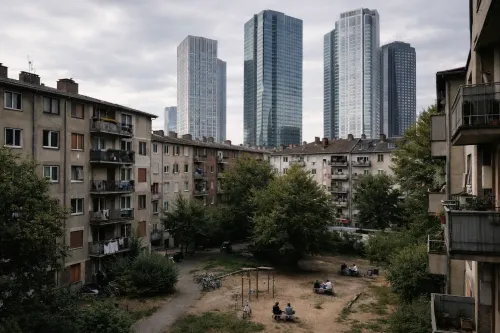
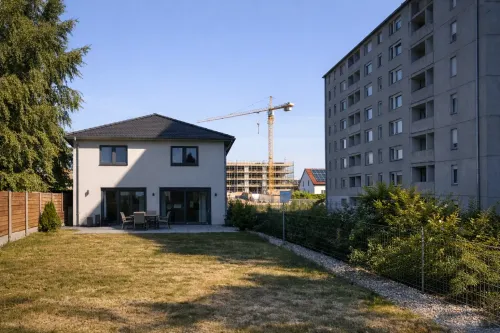
Soil sealing is a central environmental and location indicator that the report explicitly describes as important when searching for a new home. It refers to surfaces covered with impermeable materials such as concrete or asphalt. The report explains the key effect: natural soil functions are lost, and the ground can absorb and filter less water, which can negatively affect both the environment and quality of life in the neighborhood. For property decisions, this translates into several practical aspects. Heat and microclimate: heavily sealed surroundings store heat and release it more slowly. That affects outdoor comfort in summer, creates urban heat-island effects, and can indirectly increase cooling needs. The hardness of the street environment: high soil sealing often correlates with dense building structures, traffic surfaces, and less natural ground. That is not automatically bad, but it is a clear location profile, more urban, more functional, and less buffered by greenery. Shadow and lighting logic: the report also points to a relationship that often surprises people. A very high degree of soil sealing in the immediate surroundings can be associated with problematic shadow casting and can impair natural lighting and living conditions, which is why the proximity and height of surrounding buildings should also be considered when evaluating a property. This shows why Relocheck treats these topics as a system: sealing, built density, and daylight are interconnected. Comparing two locations: the report emphasizes that comparing two apartments using soil-sealing maps is an effective approach. In practice, that means if two properties are similarly priced, a clearly less sealed environment can be a strong differentiating factor, especially for target groups that prioritize outdoor time, family life, or a more open residential feeling. The soil-sealing map is therefore not an environmental extra, but a factual location indicator that makes neighborhood quality and environmental conditions transparent.
Minimum Distance to Areas with Low Soil Sealing: What This Value Means for Residential Feel and Neighborhood Density
The report also introduces a distance indicator for this topic: a short distance to areas with low soil sealing is important for people who prioritize a less burdened living environment and higher well-being. At the same time, the report describes a typical correlation: properties closer to regions with low soil sealing usually correspond to areas with lower building density. In practice, this is a very good profile signal. If the distance is short, you are more likely to have quickly reachable areas that feel more open, less hardened, and often more pleasant for walking or other outdoor activities. For families, this often means more options for stroller routes, movement and play, or simply more breathing space in the surroundings. For renters or buyers focused on quiet and recovery, lower sealing often correlates with less traffic pressure and more open-space character, without romanticizing it. Again, distance is not the same as quality. A low-sealing area may be a sports facility, the edge of agricultural land, a waterside zone, or a semi-natural corridor, depending on what the land-use map shows. The best reading is therefore: distance indicator equals fast filter, land-use map explains the type of area, green-space map shows its recreational and greenery profile.
How to Combine the Three Maps into a Clear Location Decision
The decisive step is to read the three visualizations as a complementary system, because each answers a different question. The land-use map answers: what function does the neighborhood have? It shows whether the surroundings are primarily residential or mixed urban fabric, commercial or industrial, or more agricultural or nature-oriented. That is the context explaining many everyday patterns such as movement flows, daily rhythm, infrastructure, and possible burdens. The green-space map answers: how green is the environment really, and how is greenery distributed? It gives you the density picture and shows whether green space is broadly present or only occasional. The soil-sealing map answers: how hardened is the surrounding area, and how exposed might it be to heat? It shows the permeability and sealing profile, in other words the environmental and surface character of the neighborhood. A practical comparison logic for two apartments with the same rent or purchase price might look like this. Apartment A: strongly urban land use, moderate green-space map, high sealing. Profile: urban, harder surroundings, greenery only in selective pockets. The decision then depends on whether short routes and urbanity are more important to you than outdoor quality and microclimate. Apartment B: mixed urban land use, high green-space map, moderate sealing. Profile: urban, but more buffered by greenery and with a tendency toward better outdoor quality. The goal is not to judge one as universally right, but to compare objectively. Anyone systematically reviewing several properties can use these three maps to quickly see which homes fit the desired location profile and which ones may seem attractive but do not fit structurally.
- ✓ Keep the role of each map separate: land use equals function, green equals density and recreation, sealing equals surface and climate indicator.
- ✓ Always compare relatively: which apartment delivers the more suitable location profile within the same budget?
Limits and Quality: Why Data-Based Comparison Still Does Not Fully Replace an On-Site Check
A data-based location report is most helpful when it is also transparent about its limits. The report notes that despite high quality-control standards, accuracy and completeness cannot be guaranteed in every case due to the large amount of information analyzed, and it recommends seeking additional serious professional support for important decisions. For land use and green space, this means using the maps as an objective comparison basis and as a generator of questions, then supplementing them pragmatically when a decision is close. Check barriers and crossings on site, such as major roads, fences, or rail tracks, because they change the real usability of green areas. Briefly experience the quality of the nearest green space: is it mostly a transit strip, a sports field, a play area, a park, or a more natural space? Assess the summer and heat feeling in the street environment, especially in heavily sealed areas where this can be very noticeable. In this way, the strength of the Relocheck approach remains intact: standardized, data-based transparency combined with targeted and efficient reality checks exactly where they matter for the decision.