Shadowing from Neighbors: When Your Dream House Ends Up in the Shade
A sunny plot can become unexpectedly dark because of neighboring buildings, later development, or tall trees. This article shows how buyers and investors can assess shadowing systematically, from orientation and seasonal shadows to surrounding building heights. It also explains how to read sunshine-hour, shading, and building-height visualizations so they support a solid purchase decision.
12.03.2026
Why Shadowing Is a Real Risk for Living Quality and Long-Term Value
Shadowing is one of those factors that is easy to underestimate on first impression and then feel every day later on. Anyone buying a house is not only deciding on layout and fittings, but also on the light profile of the location. How often is the garden usable? How bright are the living spaces really? How well do the terrace, conservatory, or home office work over the course of the day? And how stable will that remain over the years? The problem is that even a sunny plot can stand in the shade if the surroundings are unfavorable or change over time. This is not just a comfort issue. Less daylight can make outdoor areas less attractive, make rooms feel smaller, and increase the need for artificial lighting. For many households, especially families, light determines whether a garden or terrace will actually be used in daily life. For investors, there is a second level as well: shadowing affects not only personal use, but also the breadth of the target group and lettability. A property advertised with a garden but receiving little direct light for much of the year will simply suit some households less well. That is not a vague feeling. It is a question of whether everyday expectations are actually met.
- ✓ Treat shadowing as a location risk, comparable to noise: it is felt over the long term and is difficult to fix later.
- ✓ Do not check only living rooms. Terrace, garden, courtyard, and outdoor spaces are often the first losers when shade becomes a problem.
The Most Common Causes: Neighboring Buildings, Trees, and Future Development
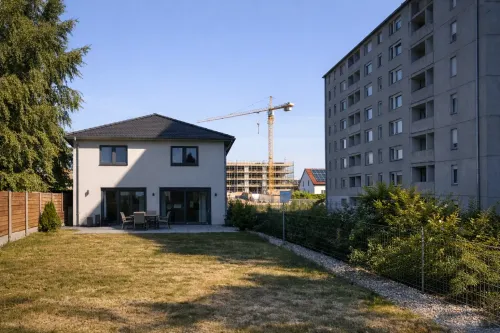
Shadowing rarely comes from a single cause. In practice, several sources usually overlap. Neighboring buildings and dense development matter because tall or close buildings create shadow edges that move over the day depending on the sun’s position. This is especially relevant when a plot sits in a kind of street canyon or when taller structures stand on the south or west side. In that case, you do not just lose a little sun, but often exactly the time windows when you would want to use outdoor areas. Trees and vegetation are another source. Tall trees can provide welcome shade in warm months, but they can also become a problem if tree cover is very dense and blocks the relevant light times, for example in the afternoon. It is also important that trees change over time through growth and have different seasonal effects depending on the species, with foliage in summer and less shielding in winter. Future development is the underestimated issue. The real question is not only the environment today, but how it may develop. A plot can feel open today, but if an adjacent site allows an additional floor, a new building, or denser development, the light profile can shift permanently. Anyone who evaluates only the status quo misses the actual risk. For buyers, it is therefore crucial to understand shadowing as a surroundings issue. It is not enough to love the parcel itself. You need to understand what the height, density, and development potential around it mean.
- ✓ Check three sources of shadowing separately: buildings today, trees today plus growth, and tomorrow’s development potential.
- ✓ Be especially critical of tall buildings on the south or west side or narrow development corridors, because they create shade exactly during the key usage times.
On-Site Checks During Viewings: How to Spot Shadow Traps Without Technology
Even without measuring equipment, many shadow traps can be identified if you follow a structured approach. First, do not rely on just one appointment. A viewing on a sunny Saturday afternoon is often the friendliest light situation. The more important question is how the light works in the morning from the east, in the afternoon and evening from the west, and what it would be like in winter. Second, read shadow edges. Pay attention to clear shadow lines from neighboring buildings on the facade, terrace, or garden. If the shadow edge already covers key outdoor areas in the afternoon, that is a warning signal. Third, look at room logic. Check which rooms need light. Living room, kitchen, dining area, and home office are especially sensitive to missing direct light. Bedrooms may be less critical, depending on preference. Fourth, assess vegetation consciously. A large tree can be a plus because of summer cooling, but also a minus because of permanent shade. What matters is where the tree stands in relation to the sun and whether the shadow times collide with your usage times. Fifth, ask the neighborhood. Short conversations with neighbors often provide the most useful clue: when is the terrace sunny, or is the garden practically always shaded in winter? These statements are not perfectly objective, but they help you ask the right data questions. The goal is not to force perfect sun. The goal is to avoid surprises. If you know the real light windows, you can decide consciously whether they fit your daily life.
- ✓ Always think of light as time windows, morning, midday, and evening, not as a snapshot from one viewing.
- ✓ Check shadow edges on outdoor areas. Terrace and garden are the fastest indicators of real shadowing.
Development Plan and Surrounding Area Changes: What Buyers Should Check Specifically
If shadowing from neighbors is the issue, today’s view is not enough. What matters is whether the surroundings will stay the same. For buyers, a pragmatic review path helps. Which adjacent areas are undeveloped or look like reserves, such as parking lots, gardens, vacant sites, or low side buildings? Are there signs of densification in the area, such as cranes, recently densified projects, or changed uses? What does the municipality say about permissible building height, development density, and building lines nearby? Are there already building applications, planned projects, or zoning and development-plan changes? These points are not meant to create fear. They are meant to make a rational decision possible. Anyone buying a house is also buying the probability that light, views, and outdoor quality will still feel similar in five to fifteen years. For investors, one additional point matters: a location may still be attractive despite today’s shadowing if the property is clearly cheaper for that reason and the target group, such as people who prefer shade or a cooler garden, remains large enough. But that has to be a conscious decision rather than something that happens by accident.
- ✓ Treat the surroundings as part of the purchase. Densification potential can permanently change the available light windows.
- ✓ If you are unsure, review municipal or planning documents about height and density in the immediate surroundings, not only for your own plot.
How to Interpret Sunshine Hours and Shading Correctly: Heatmap, Monthly Maps, and Directional Values
To keep shadowing from turning into a purely intuitive decision, a visualization that shows light and shade as patterns is helpful. A shadow map shown as a heatmap is best read as a distribution of daylight hours, not as pretty versus bad. Bright areas stand for lots of light, darker areas for stronger shade. For property searches, what matters is whether the property lies in a generally bright zone or near a shadow edge that moves across outdoor areas or facades. Monthly maps are the key to avoiding wrong decisions. Over the course of the year, the sun’s position changes. In winter the sun is lower, shadows become longer, and some plots lose direct light exactly when you notice it most, during the darker season. A monthly view helps reveal whether an area feels friendly in summer but remains shaded almost continuously in winter. Directional values, north, south, east, and west, are especially useful when talking about actual use. East means morning light, which is good if breakfast and the start of the day should be bright. West means afternoon and evening light, often important for terrace use after work or school. South often brings the strongest direct-light component if there are no barriers in front of it. North tends to bring less direct sunlight and can quickly feel darker in dense development. Especially when shadowing from neighbors is the issue, the combination matters: monthly maps show when shade becomes critical, while directional values show whether the relevant usage times are affected.
- ✓ Always include monthly maps in the assessment. Winter shows the toughest conditions with the longest shadows.
- ✓ Map the directional values to your daily life: which time windows need light for terrace, dining area, or home office?
Horizon Display and Building Heights: How to Tell Whether Neighboring Development Blocks Light Permanently
When shadowing from neighbors is a risk, it is not enough to count sunshine hours alone. You need to understand whether buildings or terrain block the sun at specific times. A sun-position analysis shown in a horizon display visualizes the annual course of the sun and represents terrain and neighboring buildings as an obstacle horizon. The logic of the lines is decisive. Where sun paths lie above the obstacles, direct sunlight is possible; where they lie below, it is blocked. This makes it easy to see whether the issue affects only short marginal periods or whether key sun paths are regularly blocked. A building-height map can then add another layer by comparing the average building height in the surroundings with the broader area. For buyers, the interpretation is simple: taller surrounding development can limit access to natural light and views, while a property that sits comparatively higher may feel less boxed in. From a shadowing perspective, what matters most is whether nearby building heights are above the local average, because that points to surroundings that take away more light than they provide. One important point is that building heights are not only an issue of views. They are a direct indicator of how likely permanent shadowing from building masses is, especially when taller structures stand in the directions relevant for sunlight.
- ✓ Use the horizon display to understand blocked versus possible sun paths: do buildings or terrain obstruct central sunlight windows?
- ✓ Read building heights in the surroundings as a shadowing indicator: taller surrounding development means a higher risk of reduced direct light.
Model Limits and Reality: What the Data Does Not Show, and How to Safeguard the Decision
For the decision to remain robust, you need to know which parts of reality are not fully contained in a shadowing analysis. One important point is that cloud cover and tree cover can strongly influence the actual amount of light received. That is why the data should be read as a structural baseline, meaning orientation and shading from buildings and terrain, and then supplemented deliberately: how dense is the vegetation really, how tall are the trees, and how does this change in summer? Trees in particular deserve a sober look. Very dense tree cover nearby can create problematic shade, while moderate vegetation can improve the microclimate. What matters is whether the vegetation blocks the desired light windows. A practical safeguard plan is simple: data check for patterns across months and directions, on-site check at relevant times of day, and a review of surrounding-area development and planning status. That turns the gut feeling that there is shade into a traceable decision: where does the shade come from, when does it occur, how stable is it, and does that fit the intended use and value expectations?
- ✓ Use the data as a baseline, but also check trees, cloud cover, and the interior impact separately.
- ✓ Apply a three-part decision frame: data for patterns, on-site experience, and planning documents for the future.