Safe Living: How Location Influences Your Sense of Security
Safety is a core criterion for many home seekers, especially families and older people. This article shows which location factors shape the feeling of safety in everyday life, how to use reliable information sources such as police and municipal statistics, and how demographic and location-based indicators in the Relocheck report can help place risks and expectations in context calmly and realistically without jumping to conclusions.
12.03.2026
Sense of Security vs. Actual Safety: Why You Should Check Both
When people look for a safe residential neighborhood, they usually mean two things at the same time: their personal sense of safety in everyday life, for example on the way home in the evening, and objectively measurable risks, such as recorded incidents in an area. These two levels are related, but they are not identical. The sense of safety is strongly shaped by immediate visible signals: lighting, lines of sight, foot traffic, well-kept paths, the way street space is used, and whether people move there normally or tend to avoid it. Objective safety, by contrast, is reflected through data sources that vary in availability by city and region, such as police reports, municipal safety reports, or open data portals. For a solid location decision, it helps to separate the two systematically and then bring them together. Personal feeling helps you make everyday decisions that work in practice: would I walk here alone at night, do routes feel safe for children? Data helps reduce perception errors: a strange feeling may be random, while a good feeling may hide important risks. Relocheck does not provide direct crime figures. That matters because crime is its own data domain with its own sources. Even so, report modules, especially demographics and neighborhood context and, where available, location-based context data such as traffic or noise indicators, can help structure your sense of safety. Not as proof, but as a smart checklist of which location aspects deserve deeper review.
- ✓ Evaluate sense of safety in everyday life and safety data from statistics separately, then combine them.
- ✓ For families and seniors, define critical routes such as the way home, school route, or route to the doctor or pharmacy and check those specifically.
Which Location Factors Most Strongly Influence the Feeling of Safety in Everyday Life
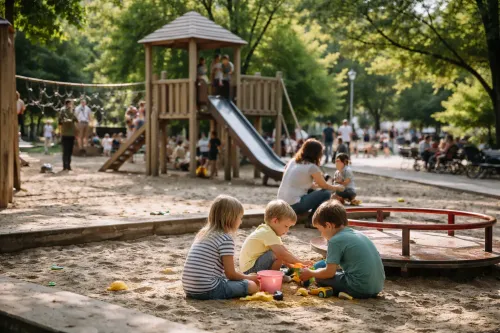
Many factors that people experience as safe or unsafe are very practical features of the built environment. The most important ones can be framed as clear checkpoints. 1) Lighting and visibility. Good street lighting, even light distribution, and clear lines of sight, without long dark bottlenecks, significantly improve the feeling of safety. The question is not just whether there are streetlights, but whether path sections are evenly lit and whether there are dark gaps, underpasses, or poorly visible corners. 2) Foot traffic and natural surveillance. Places where people are regularly present, for example because of local services, public transport stops, restaurants, or playgrounds, often feel safer because you are not alone and behavior is more socially visible. At the same time, very high through movement at certain points can also create stress. What matters is moderate, ordinary activity along the routes you actually use. 3) Mix of uses and daily rhythm. A neighborhood can be lively during the day and deserted in the evening, or the other way around. A feeling of safety often develops where uses are distributed across the day, for example housing plus local retail plus everyday facilities. Purely monofunctional areas, such as only offices, only industry, or only nightlife, can flip at certain times. 4) Traffic space and crossings. Safety does not only mean crime, but also accident risk. For families with children and for older people, safe crossings, reduced speed, sidewalk width, and good visibility are decisive. A feeling of insecurity can also come from traffic pressure. 5) Maintenance and orientation. Well-kept paths, functioning infrastructure such as intact lighting, and good orientation through clear signage and legible routes reduce insecurity. This is not a moral marker, but a practical one: when you can orient yourself safely, you feel less exposed. These factors are easy to check on site, ideally at several times, such as early evening, late evening, and on weekends. The key is not just to walk around casually, but to deliberately walk the routes that will later matter in everyday life.
- ✓ Do an on-site check at two to three times: weekday evening, later evening, and weekend.
- ✓ Test the critical route chain: apartment to public transport or car, then to local services, school, or pharmacy, not just the pleasant route.
Which Sources Really Help: How to Research Safety Reliably
Because Relocheck does not include direct crime data, a clean mix of sources is the best solution. For the most objective assessment possible, the following are especially useful. Police statistics and safety reports: depending on the country or city, published crime statistics are available, often at district or municipal level. What matters is how finely the data is broken down and which offense types are shown. Pay attention to whether the numbers are absolute figures or rates per resident. Municipal open-data portals: some cities provide data on lighting, traffic volume, accident hotspots, or complaints. Traffic and accident risk are often just as relevant for families as crime. Neighborhood apps and local forums, with caution: these can provide hints about recurring problems, such as poorly lit routes or places people subjectively avoid, but they are heavily shaped by individual opinions. Use them as pointers, not as proof. On-site conversations: brief conversations with people who actually use the area, for example at a playground, in a cafe, or at a supermarket, often provide a realistic sense of which issues really matter in daily life. Ask concrete questions, such as whether there are routes they avoid in the evening, instead of asking a broad question such as whether the area is safe. The most important rule is not to rely on one source alone. Good decisions arise when several sources plausibly support each other. That leads to the next question: how can a location report still help even without crime figures? This is exactly where demographic and location-based context indicators become useful, as a structure for your review, not as a replacement for police data.
- ✓ Use at least two independent sources, for example a police report plus municipal data plus an on-site check.
- ✓ When reading statistics, check the offense types and prefer per-capita figures where available.
What the Relocheck Demographics Report Can Contribute to the Assessment Without Claiming Crime Data
Even without crime data, a structured demographics report can help classify a neighborhood and understand typical everyday dynamics. The important expectation is the right one: demographics are not proof of safety. But they do provide context that often relates to the experienced sense of safety, for example through stability, daily rhythm, and usage patterns. In the demographics module, key figures are summarized for a defined surrounding area, typically one square kilometer, and supplemented with visualizations that create a location profile. Three elements are especially helpful for the topic of safe living. 1) Age structure as a clue to daily rhythm and neighborhood logic. A neighborhood with a higher share of families or older people may have different everyday routines than an area shaped strongly by young adults. This is not a value judgment, but it influences how street space is used, for example more activity in the morning and afternoon versus more activity in the evening. The age structure is shown in the report as a clear overview. 2) Household structure as a signal of neighborhood dynamics. Many one-person households often indicate more urban, mobile target groups, while more three- to five-person households are more common in family-oriented locations. For the sense of safety, the relevant question is which routes dominate daily life, such as children's routes, late evening routes home, or local errands, and how likely natural surveillance in public space is at typical times. 3) Residential moves, inflow and outflow, as a stability indicator. The report shows residential moves as a dynamic component. That helps with the question of whether an area is more settled or more in motion. For the feeling of safety, stability can mean that routines and orientation are easier to build, while high dynamism can mean the environment changes faster. Both profiles can work well, but they feel different. The report may also include hints such as micro-location comparison and context indicators that help classify the surroundings. The benefit is that they make differences between locations visible. Two addresses may look similar but have a completely different neighborhood profile.
- ✓ Read demographics as context: which everyday rhythms and user groups seem plausible, without deriving safety directly from them?
- ✓ Check residential moves: more stable versus more dynamic, then see on site how that actually feels.
Using Indirect Signals Correctly: How to Derive Useful Questions from Demographics and Environment Factors
The biggest mistake when thinking about safety is to turn indirect indicators into direct judgments. The right approach is to use indicators to ask the right questions. Here are examples of sound interpretations. If a neighborhood is very dynamic, with high residential turnover, the question is not whether it is unsafe, but how the environment is changing and how stable your everyday routes are. Check public transport access, lighting on routes home, and how intensively the area is used in the evening. If a neighborhood seems strongly family-oriented, the question is not whether it is safe, but whether children's routes are designed safely. Check crossings, speed levels, lines of sight, and whether there are many safe routes to school or the playground. If a neighborhood is strongly shaped by young adults, the question is not whether it is dangerous, but what the nighttime and weekend rhythm is like. Check whether there are high-frequency nightlife locations in your micro-location and how that affects quiet and routes home. If additional location-based data such as traffic noise or traffic load are available, for example as noise or traffic context in a location report, they can also provide clues, not about crime, but about activity patterns, through traffic, and stressors that influence the sense of safety. This creates a practical mechanism: data, then hypothesis, then targeted on-site check, then decision.
- ✓ Turn every metric into a review question or hypothesis instead of a judgment.
- ✓ Prioritize the micro-location: the feeling of safety is created on the actual daily routes, not across the whole district.
Practical Guide for Families and Seniors: The 10-Minute Safety Check During a Viewing
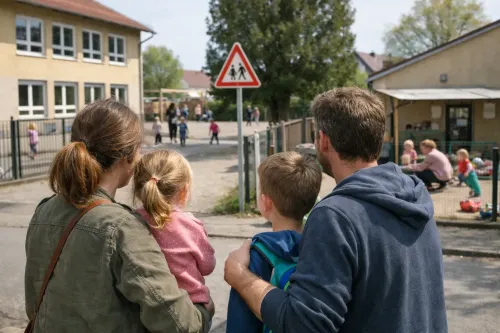
Especially when viewings are tightly scheduled, a short standardized check helps. 1) Simulate the route home. If possible, walk from public transport or the car to the apartment. Pay attention to lighting, clarity, and blind spots. 2) Check children's routes and everyday routes. What would the path to kindergarten, school, pharmacy, or supermarket look like? Are there safe crossings and wide sidewalks? 3) Look at places where people stay. Are there places where people are present in an ordinary way, such as a playground, bakery, or park? That is often a good sign of normal social everyday use. 4) Notice the sound and traffic context. Heavy traffic can create stress and make children's routes riskier. That is also part of safety. 5) Briefly observe neighbors and the surrounding area. Do not evaluate people, but look for patterns: does the area feel active during the day and completely empty in the evening? Where are the high-frequency corridors? 6) Add a data check. If you remain unsure, then review police statistics or municipal reports for the district afterward and put the numbers into relation by offense type, per resident, and time period. For seniors, additional points may matter, such as barrier-free routes, safe crossings, seating options, and orientation through signage and clear routes. For families, school-route safety, speed, visibility, and safe play areas matter most. This check does not replace data analysis, but it helps you identify the most important everyday risks in a short time instead of only after moving in.
- ✓ Always test the route home and the child route by actually walking them at least once.
- ✓ Treat traffic safety as part of overall safety: crossings, speed, and lines of sight matter.
- ✓ If feeling and data contradict each other, plan a second on-site visit at a different time of day.
Important Limits: Fair Interpretation and No Shortcuts
One clear boundary matters at the end: demographic structures are not a safety metric. They help you understand life stages, stability, and everyday rhythms, but they do not replace crime data and must not become a shortcut for prejudice. Anyone deciding seriously avoids shortcuts: no sweeping judgments about people or groups, no logic that equates safety with demographics, and no decision based only on apps or isolated reports. Instead, a robust method works like this: data from the location report for context, official safety and traffic data for objectivity, and an on-site check at relevant times for real everyday life, leading to a traceable decision. That turns safe living into something that can actually be examined, without fear-based marketing but also without naive optimism.
- ✓ Never use demographics as proof of safety. Always supplement them with official sources and an on-site check.
- ✓ If you are unsure, do not guess. Check targeted data from police or municipalities and verify at different times of day.