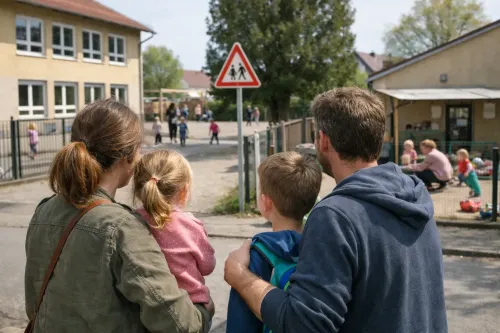
Choosing Where to Live with Children: School and Childcare as Location Factors
For families, school and childcare are hard location factors. Short, reliable routes reduce everyday stress and improve planning certainty. This article explains how parents can compare travel and walking times objectively with isochrones for car, walking, and cycling, prioritize education locations, and identify residential areas where education options are truly reachable in daily life.
12.03.2026
Why School and Childcare Shape Where You Live More Than Most People Think
For families, the question of location is not only where it is nice, but where daily life works reliably. School and childcare are the key fixed points because they set the rhythm on weekdays. A short route to school or childcare reduces not only time spent, but also complexity: fewer detours, fewer last-minute emergency solutions, and less stress when someone is ill or the schedule is tight. There is also a social effect that often becomes visible only later. The closer education facilities are to home, the more likely children are to build friendships in the neighborhood and parents to become connected locally in everyday life. This affects care, leisure, and organization, which are all factors you rarely see in a property listing but feel every day. The key is therefore an objective question: how good is the education infrastructure within the range that is truly practical for your family, not just somehow reachable, but reachable within a time window that is realistic in the morning and afternoon?
The Family Logic Behind Education as a Location Factor
Routes to school and childcare are rarely single trips. In practice they form chains of trips: one parent drops off at childcare, the other takes a child to school, then work follows, then later the return trip, often with intermediate stops such as shopping, doctor appointments, or sports. Anyone who checks only the route to school often overlooks the overall burden. For the location decision, it helps to separate two perspectives. The first is daily reliability: can the typical morning work without a sprint and without constant buffer time? That depends less on the perfect minimum time and more on how stable the route is. The second is long-term suitability: does the location still work if mobility changes? For example, if children are later meant to get to school independently, if one parent is less mobile for a while, or if a car is no longer available. These two perspectives lead to a clear data requirement: parents need a comparison across several transport modes, not only car, but also walking and cycling. This is exactly where isochrones are especially helpful as a visualization, because they show accessibility as areas of time.
Understanding Isochrones: What the Tool Measures and Why It Is Better Than Straight-Line Distance
Isochrones are time maps. They show not how far something is away, but which areas can be reached within a defined time window. That is decisive for routes to school and childcare because family routes can be strongly shaped by barriers: crossings, detours, one-way systems, missing underpasses, rivers, or heavily trafficked axes. The most common mistake in housing searches is to confuse proximity with accessibility. A school may appear just around the corner on a map, but in reality be located in a way that makes the route much longer on foot or by bike. Conversely, a destination may look farther away but be quickly reachable through a good network of paths. Isochrones solve exactly this problem by showing reach as realistic time logic. For parents, that means comparing residential locations not by feeling, but by asking which education options lie within a time window that works in daily life, and whether that works with the means of transport the family actually uses.
How Parents Can Use Isochrones for School and Childcare in Practice
For isochrones to actually help when choosing where to live, parents should proceed in a structured way. Step one is defining the starting point. The start is the specific address or the planned residential location. What matters is that you use the same logic for all properties being compared. Step two is defining the transport modes. For families, it makes sense to check at least three scenarios: car, walking, and cycling. These scenarios are not just alternatives. They reflect different life situations, such as a child in a stroller, a child later cycling independently, or one parent without a car. Step three is thinking in time windows rather than one exact number. Which schools and childcare facilities are clearly in the short range, which are only just reachable, and which are practically unsuitable for daily life? Especially the category just reachable is a warning sign, because small disruptions can tip the routine into stress. Step four is checking education destinations as a cluster. Do not assess only one childcare facility or one school, but several options within reach. For families, redundancy matters. Place availability, educational preferences, or school assignments can change. If you proceed this way, the isochrone tool becomes a filter that shows very quickly which residential locations meet your education logic and which do not.
How to Interpret Isochrones Correctly: Stability Beats Minimum Time
Many parents look for the shortest possible travel time to school. In practice, something else is often more decisive: stability and predictability. A location may theoretically reach a school quickly, but only via a route that depends heavily on traffic peaks. Or it may be possible on foot, but only via detours with awkward crossings. Isochrones help make these risks visible because they show reachable areas in time windows and therefore make it clear whether good accessibility is broadly supported or rests on a fragile route. A simple rule helps with interpretation: the more education options lie within a short time window, the more robust the location is. Robust means less stress when small disruptions occur, more flexibility when things change, and less dependence on a single transport mode. This becomes especially relevant when children transition toward independence. If they are later meant to get to school on their own, what matters is not the car isochrone but the walking or cycling reach. A location that looks good only in the car scenario can be less family-friendly in the long term than it first appears.
Accessibility Tables for Education Destinations: Why Option 2 Is Gold for Families
Alongside maps, a tabular accessibility overview is especially helpful because it lists concrete destinations and makes times quickly comparable. For families, one point is central: not only the closest option matters, but also the second good option. Why? Because education facilities have real-life constraints: place availability, admission criteria, care hours, educational profile, and catchment areas. A location with only one childcare facility that can be reached quickly is organizationally riskier than a location with two alternatives that work in daily life. The useful interpretation is therefore simple. Option one shows the fastest possibility. Option two shows the resilience of your location. If option two is significantly worse or practically does not work, dependency arises. If option two is also workable in daily life, flexibility increases, and for families that is often more important than a single record-low minute count.
What Else Parents Should Pay Attention To: Education Is More Than Travel Time
Isochrones answer the question of accessibility. But for a good location decision, parents need to separate two additional levels clearly. First, accessibility is not the same as safety. If a school route is short but runs along heavily trafficked axes or awkward crossings, that can change how practical it really is. Isochrones are an excellent starting point for identifying the relevant routes, but the safety assessment should then be carried out deliberately along that route. Second, accessibility is not the same as availability. A location may have many childcare options within reach and still face a difficult place situation. Data helps you ask better questions, but it does not replace the organizational check. Third, daily rhythm matters. Parents should think of routes at typical times: in the morning under time pressure, in the afternoon during pickup, sometimes with a detour via work or shopping. A location that works only in an idealized scenario will quickly become a burden in everyday life. The best practice is therefore to use isochrones as an objective filter, then test two or three real routes to the preferred facilities, and finally check the organizational conditions.
How to Compare Several Residential Locations Fairly: A Compact Decision Framework for Families
When families compare several residential locations, it helps to use a simple, repeatable framework that is filled out the same way for every address. First, education reach by transport mode: which schools and childcare facilities lie within a short and practical time window on foot, by bike, and by car? Second, redundancy: are there at least two sensible options, option one and option two, or does everything depend on a single offer? Third, future scenario: does the location still work if children later travel independently or if mobility in the household changes? Fourth, on-site checks: which routes do you need to test in reality, including crossings, barriers, and the feeling of safety at peak times? This framework makes the comparison objective and traceable. It also ensures that families do not end up choosing simply the nicest apartment, but the location that supports their education routine most reliably.