Big City or Suburb: What Is Better for Children?
Big city or suburb: for families, this is rarely a matter of taste alone. It usually means weighing accessibility, everyday logistics, green space, and peace and quiet. This article shows which factors parents should compare realistically and how to interpret Relocheck visualizations, isochrones and commute times as well as green space and land use, so that city and outskirts can be compared objectively.
12.03.2026
Big City vs. Suburb for Families: The Decision Is an Everyday Calculation
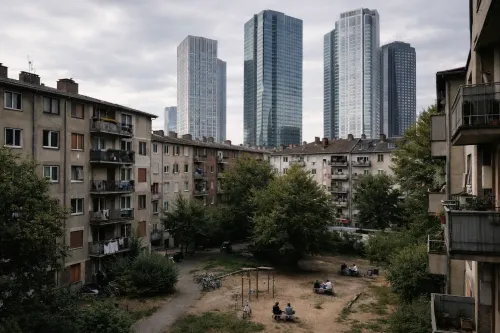
When families talk about big city or suburb, they usually have two pictures in mind: in the city, everything is close, school, activities, friends; in the suburb, it is greener and quieter. Both can be true, but the decisive question is this: what does weekday life actually look like? For parents and children, a location works well when daily routes function reliably: low stress in the morning, spontaneous options in the afternoon, and calm in the evening. This can be translated into three blocks that can be compared with data: 1) accessibility of important destinations within realistic time windows, 2) green space and land use, and therefore outdoor quality of stay, 3) mobility dependency, meaning how strongly family life depends on the car or on transfers. The goal is not to make the city or the suburb look better. The goal is to understand which environment fits your family model: daycare or school age, commuting patterns, hobbies, the desired independence of the children, budget, and how stable these factors are likely to remain.
Commute Times and Isochrones: Why Maps Often Tell You More Than a Single School Route
Many families first check one single route: how long is it to school, or how long is it to work? That matters, but it is too narrow. Everyday life means several trips per day, drop-offs and pick-ups, shopping, the doctor, sports, friends. Isochrones help make this network visible. Isochrone maps show the areas you can reach from a starting point within a defined time span, typically in minutes. In the report, these areas are displayed using lines and color coding so you can see at a glance which zones are reachable in 5, 10, 15, or 20 minutes; darker colors indicate longer travel time. Unlike simplified circles, isochrones can take into account road conditions, traffic volume, and transport options, making them more realistic for location comparisons. This is crucial for the city versus suburb question: in the city, the reachable everyday area is often large within a short time because destinations are dense. In the suburb, the everyday area on foot or by bike can be much smaller, while by car it may suddenly look large. Parents should see these differences clearly before relying on one single route that may happen to look favorable.
How to Interpret the 5 to 20 Minute Time Windows: Everyday Needs vs. Nice to Have
The report uses time windows such as 5, 10, 15, and 20 minutes, as well as more than 20 minutes, to structure accessibility. For families, it helps to attach an everyday logic to these windows. 5 to 10 minutes: this is the core of spontaneity. Destinations in this range are truly used incidentally in daily life, quickly stepping out and quickly getting there. In the big city, these destinations are often more numerous; in the suburb, it depends heavily on the local center. 10 to 20 minutes: this is the range for planned routines. Sports clubs, doctor appointments, bigger shopping trips, these work well when the route is stable and does not regularly break down, for example because of commuter traffic. More than 20 minutes: the report describes this range as acceptable for larger destinations such as hospitals, airports, or universities. For families, that means these are occasional trips. It becomes critical when everyday destinations, daycare, school, routine shopping, friends, regularly fall into this range, because then time pressure and dependency increase. This framework helps compare city and suburb fairly: not who has more green space, but where our daily destinations lie within the time zones that actually ease family life.
Car, Bicycle, On Foot: A Suburb Often Feels Good Only with a Car, and That Is a Risk
The report shows isochrones for different modes of transport, car, bicycle, and walking. This is exactly where a typical bias appears: a suburban location can look excellent if you assume the car as the default, but much less so if children are meant to become independent later on. For families, the most important comparison question is therefore this: what does accessibility look like without a car? If the pedestrian isochrone covers hardly any important destinations within 10 to 15 minutes, that can mean children will remain dependent on being driven, spontaneous meetings with friends become harder, and every everyday task requires extra organization. If the bicycle isochrone shows a solid range of destinations, school, sports, friends, that points to greater independence for children, a factor that becomes very important in primary school and certainly by adolescence. The car isochrone still matters, for example for commuting or larger shopping trips. But the more a location works only through the car, the more vulnerable it becomes to traffic peaks, parking issues, and family logistics. In this context, isochrones are not a nice extra, but a view of structural dependency.
The Accessibility Table in the Report: Why “Option 1/2” Is Gold for Families
Alongside the maps, the report uses tables that list the two nearest options for each destination type, for example daycare, school, pharmacy, or supermarket, together with the required travel time. The same color scheme is used here as well; gray means the destination is not reachable within the specified time. For families, this logic is very practical because it shows the redundancy of a location. If there is only one reachable option for daycare or school, the location is more vulnerable, capacity limits, catchment areas, relocation, or routine changes. Two good options mean more flexibility. If option 2 is much slower than option 1, that can indicate that the infrastructure exists but is spatially concentrated. That is common in suburbs, where the local center bundles many services, while big cities often offer several alternatives in different directions. Parents can therefore read the table as a stability check: not just does it work, but does it still work if plan A fails.
Green Space and Land Use: What Suburbs Often Do Better, and What You Should Check Precisely
Suburbs often score with more greenery, closer access to natural areas, and less dense development. But precision also matters here: more green does not automatically mean more usable. The report emphasizes that green areas have a significant influence on residential quality and that green space maps display the density of vegetated areas in a region using a green color scale. For comparing city and suburb, this means: in the big city, a location can still work very well despite having less total greenery if green space is well distributed, smaller parks, green routes, courtyards. In the suburb, there may be a lot of green space that is not practical in everyday life, for example large areas at the edge but little within walking distance. The report also identifies the minimum distance to the nearest green space as an important indicator because it supports outdoor activities and can be associated with environmental benefits such as cooling. For families, the sensible interpretation is therefore not only how green, but how reachable and how well distributed. If the suburban location offers green space only after a car trip, everyday life is less relieved than the landscape might suggest.
Surface Sealing: Why “Lots of Asphalt” Can Quickly Reduce the Suburban Advantage
Another component in the report is surface sealing. The text makes clear that the degree of sealing in the surrounding area affects attractiveness and that short distances to areas with low soil sealing can indicate a less burdened residential environment. The accompanying topic papers also explain why high sealing can contribute to overheating in summer and problems during heavy rainfall. This is surprisingly relevant for city versus suburb: suburbs are not automatically less sealed. New-build areas with large parking surfaces, wide access roads, and little tree cover can heat up significantly in summer even if the setting appears green from a distance. In practical terms, parents should look at sealing and land use and ask: is the immediate environment heavily paved, parking areas, very little green strip? Are there continuous soft routes, green paths, for children? Are low-sealed areas within walking or cycling distance, or only destinations farther away? This is a good example of why data helps: it shows whether a location is truly green in everyday life or only green in the brochure.
Decision Guide: Which Type of Family Benefits More from the City, and Which More from the Suburb?
There is no universal answer, but there are patterns that can be derived from isochrones and green-space data. The big city often fits better when: you need many destinations within 10 to 15 minutes without a car, daycare, school, doctors, activities; you value spontaneous social contact, friends nearby and short routes to activities; you want to encourage your children’s independence early, with walking and cycling being realistic; your schedule is tight, two commutes and changing care arrangements. The suburb often fits better when: you prioritize calm and space and can realistically compensate for longer routes; the suburban location has a strong local center, with good walking and cycling isochrones to school, shopping, and leisure; reliable commute times, for example a well-accessible train or bus option, keep travel time stable; green space is not only present, but distributed close to everyday life, short minimum distance, and a green-space map showing density around the location. The trick is not to discuss city versus countryside in the abstract, but to compare two concrete addresses using the same review logic.
Quick Check: How to Compare City and Suburb Objectively in 15 Minutes per Location
If you compare two locations, city center versus urban edge or suburbs, a fixed grid helps: 1) Look at isochrones by mode of transport, car, bicycle, walking, and deliberately check what everyday life would look like without a car. 2) Translate the time windows: 5 to 10 minutes equals spontaneity, 10 to 20 minutes equals routines, more than 20 minutes equals exceptional destinations. Then check where daycare, school, friends, and shopping lie. 3) Read the accessibility table: compare option 1 and option 2 for daycare, school, and shopping. Two good options mean more stability. 4) Review green space: read the green-space map for density and distribution in the immediate surroundings; use minimum distance to the nearest green area as an everyday indicator. 5) Add sealing and land use: is the environment comfortable to spend time in, or dominated by hardened infrastructure? This method is deliberately simple. It is not meant to explain every nuance, but to make the biggest location levers visible, exactly the ones families will later feel in daily life.