Bright Residential Locations: Which Neighborhoods Get the Most Sunshine?
Why do some neighborhoods feel much brighter than others even though they are only a few kilometers apart? This article shows which geographic and built-environment factors influence sunshine hours in a neighborhood and how sunny residential locations can be compared using data. It also explains how to interpret maps and visualizations for sunshine hours and shading so they support a clear rental or purchase decision.
12.03.2026
What “The Sunniest Neighborhoods” Really Means, and Why It Is Not the Same Everywhere
When people search for the sunniest neighborhoods, they usually do not mean abstract astronomy, but concrete day-to-day usability: when does direct light reach the apartment, garden, or balcony, how long does it stay, and how reliably does that happen over the year? What matters is this: brightness is not a city label. It results from the interplay between the location in space and the immediate surroundings. Two districts can differ strongly because they are oriented differently, because development is denser or taller, or because topographic effects such as valleys, slopes, or elevation shorten the available light window. For renters and buyers, the central question is therefore less where it is sunny and more which locations provide the sunshine hours I can actually use, especially in the months that matter most to me.
- ✓ Define sunshine as a usage question: which time windows, morning, midday, evening, actually matter in your daily life?
- ✓ When comparing neighborhoods, do not think only about summer sun: winter and shoulder seasons determine whether a location feels bright year-round.
Why Neighborhoods Differ in Brightness: Topography, Exposure, and Urban Form
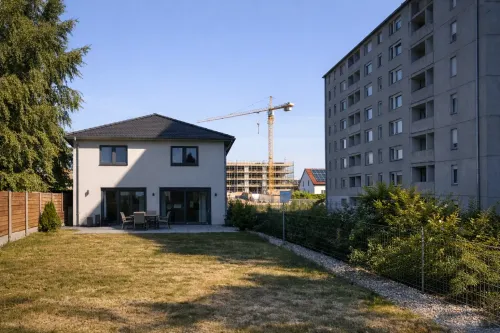
Sunshine hours within a neighborhood are mainly shaped by three factors. 1) Topography and elevation: districts on slopes or higher ground often have longer light windows because the horizon is more open. In narrow valleys, the opposite can happen: the sun’s path is the same, but terrain and surrounding ridges limit the time during which direct sun is possible at all. 2) Exposure, south-facing or north-facing: south-facing areas tend to receive more direct radiation than north-facing locations. What matters is not only the rough cardinal direction, but whether the surroundings block the sun in the relevant directions. 3) Urban form, density and building height: in dense neighborhoods, tall buildings, street canyons, or perimeter block development can create stable shadow corridors. That does not automatically mean a bad location, but it does mean that light windows need to be checked deliberately. This is practical for a housing search: if you are already weighing several neighborhoods against each other, it is worth separating these three factors consciously. Topography often explains the big brightness differences, while development explains the smaller differences from one street to the next.
- ✓ Check topography first, valley, slope, elevation, and only then building structure, street canyons, perimeter blocks, tall points.
- ✓ A sunny neighborhood does not automatically mean a sunny apartment: the micro-location, street side, courtyard side, neighboring building, can reverse the result.
How to Read the Shadow Map for Neighborhood Comparisons: A Heatmap Instead of Gut Feeling
For comparing neighborhoods, a shadow map is especially useful because it shows sunshine hours as a spatial pattern rather than as a single number. The basic idea is that daylight hours are visualized as a heatmap. Lighter areas stand for high light yield, darker areas for stronger shading. That allows you to see not only bright or dark, but also transitions: where does a shadow corridor begin, and where are the edges at which the character of the surroundings changes? This is extremely valuable when comparing districts because you can spot typical neighborhood characteristics more quickly. Open neighborhoods with broader open space often show larger connected bright areas. Dense block structures more often show fine-grained patterns with clear shadow zones. Valley locations or areas with a pronounced terrain horizon often show systematic restrictions at certain times of day. Important: read the map like a map of probability. It shows where sun is typically possible, not that every single day will have exactly the same amount of sun.
- ✓ When comparing neighborhoods, do not look only at the exact property point: pay attention to the pattern around it, bright carpet versus shadow corridor.
- ✓ Mark shadow edges: if a property lies near one, just a few meters, street side or courtyard position, can make the difference.
Annual Average vs. Winter Reality: Why Monthly Maps Make Your Sunshine Ranking Honest
Many people compare neighborhoods using an imagined annual average, it is sunny there. In practice, dissatisfaction often appears in the winter half of the year: low sun angle, short days, long shadows. This is exactly where monthly maps help. They make visible how strongly light and shade shift over the course of the year. In winter, the sun sits lower, and morning and afternoon shadows become longer. In spring and autumn, day length and solar angle change, and in summer the sun reaches its highest point. For a meaningful neighborhood ranking, this means: if you want sunshine mainly for a balcony or garden, you should at least check winter and shoulder-season months. If you want sunshine mainly for indoor brightness, living room or home office, winter reality is especially important because missing direct light is most noticeable there. A neighborhood can feel very bright in summer but lose noticeably in winter because of terrain or surrounding buildings. The best decision comes from choosing neighborhoods not only by lots of sun, but by reliable light windows.
- ✓ For rankings, always compare at least one winter month and one summer month, the most critical versus the best-case situation.
- ✓ Check shoulder months, spring and autumn, when daily routine matters: morning and evening light windows are often decided there.
The Side of the Apartment Matters: How to Interpret Cardinal Direction Values Correctly, N/S/E/W
Neighborhoods are large, apartments are specific. That is why, in addition to the map, it helps to break things down by direction. The practical logic is simple. East-facing orientation means morning light. It fits well if you want light early in the day and less direct sun in the evening. West-facing orientation means afternoon and evening light. For many people this is attractive because the sun is still there after work or school. South-facing orientation often has the greatest potential for direct light, provided there are no barriers in front of it. North-facing orientation means less direct sunlight; combined with dense development or a valley setting, it can feel noticeably darker. The consequence for neighborhood comparisons is important: a district can look bright overall, but a north-facing courtyard apartment can still have a very limited light window. Conversely, an otherwise dense neighborhood can provide surprisingly strong light at a well-oriented open edge. If you are looking for the sunniest neighborhoods, it helps to translate that into a combined question: where is the surrounding area fundamentally bright, and which apartment orientations there actually benefit from it?
- ✓ Separate the neighborhood decision from the apartment decision: first district, macro-location, then the concrete orientation, micro-location.
- ✓ Match orientation to your schedule: someone home mainly in the evening evaluates west-facing windows differently from an early riser.
When the City Lies “in the Shade”: Mountain Shadow, Terrain Horizon, and Urban Canyons
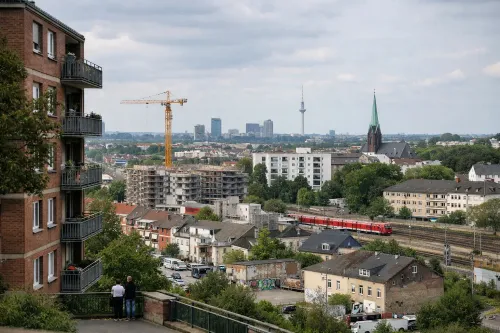
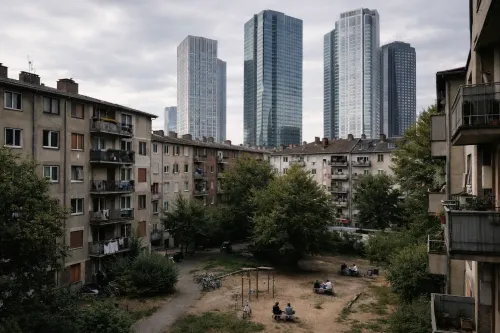
Especially in cities with noticeable topography, hills, slopes, valleys, a specific effect appears: the terrain horizon can take the sun away earlier or release it later. This is where a sun-path analysis in horizon view is especially helpful because it visualizes the yearly course of the sun and the obstacles at the horizon. The key idea is simple: if the sun path lies above the obstacle, direct radiation is possible; if it lies below, the sun is blocked. This makes it possible to understand whether a district gets sun later in the morning, falls into shade earlier in the evening, or whether only specific directions are affected. In purely urban situations, without mountains, something similar happens because of tall buildings: street canyons can form an artificial horizon. For the search for sunny neighborhoods, that means valley or canyon locations are not automatically bad, but they do require more deliberate checking. Slope locations can bring advantages, but nearby buildings can also cut into their light windows. A data-based comparison reveals these systematic effects early and saves you disappointing viewings.
- ✓ In cities with strong topography, check the terrain horizon deliberately: does the sun arrive later, leave earlier, and in which directions?
- ✓ In dense neighborhoods, watch for urban horizons: tall buildings can create effects similar to mountains.
How to Build a Useful Sunshine Ranking for Neighborhoods Without False Precision
A neighborhood ranking by sunshine hours sounds attractive, but it has to be done correctly or it creates false confidence. A practical approach is to compare representative points rather than treating an entire district as one single thing. Step 1: define the candidate list. Choose neighborhoods that already fit your budget, infrastructure needs, and daily routine. Step 2: select two to four typical micro-locations per neighborhood, for example a main street, a side street, a courtyard setting, or an edge location on a slope. Step 3: compare map patterns. Look for connected bright areas and shadow corridors. If a district is bright only in isolated points, the hit rate during the housing search is lower. Step 4: check the seasons, at least one winter month and one summer month. The goal is not maximum sunshine, but stability. Step 5: prioritize orientation. If you already know evening sun matters most, give more weight to west-facing and southwest-facing positions. Step 6: validate on site. For the top options, targeted checks at the relevant times of day are worth it. This produces a ranking that actually helps in practice, not as a marketing list, but as a decision tool that focuses your search time on the brighter, more suitable areas.
- ✓ Build the ranking from representative points rather than entire neighborhoods: micro-locations decide the outcome in practice.
- ✓ Weight stability more highly than peaks: a reliable light window is more useful in everyday life than rare maximum values.
Limits of the Analysis: What Sunshine Models Do Not Capture, and How to Add That Cleanly
To keep the decision robust, you should know the limits of this kind of analysis. Shadow maps model structural effects, orientation, terrain, and buildings, but they do not include every real-world variable such as cloud cover or tree cover. That means the map is excellent for comparing location patterns, but it does not replace looking at vegetation, local specifics, or the actual light effect indoors. In practice, you can add these factors cleanly: check trees in the surroundings, as heavy tree cover can darken a neighborhood significantly in summer. Consider indoor light effect: room depth, window height, and bright interior surfaces determine how the available light actually feels. Look at construction and development risk: if the area is densifying, the light profile may change. Anyone who consistently adds these points uses data as intended, as an objective guide for better decisions, not as a substitute for every further check.
- ✓ Always combine sunshine-hour data with vegetation and indoor light effect, otherwise brightness is easy to misjudge.
- ✓ For long-term decisions, purchase in particular, also check surrounding development: new buildings can change light windows.