City Noise vs. Suburban Quiet: Where Is It More Relaxing to Live?
Inner city or urban fringe: noise levels differ not only in volume but also in pattern, including background noise, peaks, and nighttime disturbance. This article explains the typical noise sources in the city and the suburbs, shows how to read Relocheck noise maps for comparison, and helps families weigh quiet against commute time realistically.
12.03.2026
What Really Differs: In the City, Noise Is a Pattern, Not Just a Level
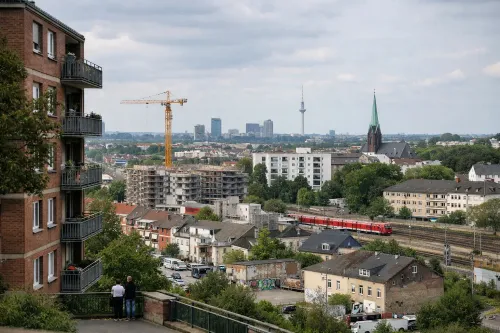
The question "Where is it more relaxing to live?" can rarely be answered in the city-versus-suburb debate with a single number. The key difference usually lies in the noise profile. In the inner city, there is often a constant background layer of sound, with more traffic, more activity, and more delivery and service traffic, while on the urban fringe the background level is often lower but individual sources may stand out more strongly, such as a main road, a railway line, or an access corridor. This matters in everyday residential life because people react differently to different types of noise. A constant moderate hum can fade into the background, while recurring peaks from motorcycles, buses, garbage collection, or late-night foot traffic often feel much more disruptive, especially at night. Families often notice the difference sooner because children and sleep schedules are more sensitive and because outdoor spaces such as balconies and play areas are used more often. So if you want to weigh city-noise comparisons against the appeal of suburban quiet in a useful way, it helps to ask one clear question: is your main priority a low everyday background noise level, or predictable quiet in certain time windows such as nighttime, nap time, or home-office hours?
- ✓ Define "quiet" as a pattern: background noise, peaks, and times of day, not just one impression from the viewing.
- ✓ For families, lock in the key time windows: night, early morning, and typical afternoons, depending on your routine.
How to Read Relocheck Noise Maps Correctly: Immediate Surroundings vs. Suburban and Neighborhood Context
To avoid letting a comparison between the city center and the urban fringe end in gut feeling, you need a consistent and repeatable way to look at noise. That is exactly what the road-noise module in the location report is built for: it visualizes potential noise levels in the area as a map model and explains that the modeling logic includes factors such as road types, speed limits, and building information. What matters is how you interpret that map. The report separates two perspectives that are especially important for a city-versus-suburb comparison. First, the immediate surroundings: this is the close-up view around the address. Here you can see whether the property sits directly on a burdened axis or inside a calmer micro-area. Second, the wider picture of the neighborhood: this is the macro view. It shows whether the area as a whole is crossed by loud corridors or whether there are larger quiet islands. This level is especially important on the urban fringe, because single axes such as feeder roads can strongly influence perceived quiet while the rest of the neighborhood remains very calm. A practical reading rule is this: if the map shows a dense network of burdened axes around the area, the probability is high that outdoor spaces and everyday routes to school, the park, or the supermarket are permanently shaped by noise. If the map instead shows clearly calm zones, a location can work surprisingly well despite proximity to the city, especially if the home itself has a quiet side.
- ✓ Always check both levels: the direct address and the neighborhood structure, otherwise the city-versus-suburb comparison gets distorted.
- ✓ Read axes as noise corridors: the point itself matters less than its embedding in a network of burdened roads.
Typical Inner-City Logic: Traffic, Mixed Uses, and Nightlife as Noise Drivers
In the city center, several noise sources often overlap at the same time. The classic one is traffic: more vehicles, more intersections, and more braking and acceleration phases. Then there is the mix of uses: delivery traffic in the morning, visitor traffic in the afternoon, and leisure traffic in the evening. Another driver is so-called social noise: people on their way home, restaurants and bars, transit stops, and taxi ranks. That is not automatically negative, and many people actively seek this level of urban liveliness. But if the goal is a quiet residential setting, city-center noise is often less easy to switch off. Even when the apartment itself is well insulated, the quality of outdoor space, open-window comfort, and nighttime quiet still depend heavily on the surroundings. For comparison purposes, this means that in the inner city, the probability is higher that noise is not just occasional but spread across the area. On the noise map, that often appears as several nearby axes and nodes dominating the overall picture.
- ✓ Do not assess the inner city based only on the residential street: junctions and adjacent axes often shape the real sound profile.
- ✓ Check nightlife risk actively: not just whether it is loud or quiet, but whether recurring peaks from voices, taxis, or doors occur regularly.
Typical Suburban Logic: Lower Background Noise, but Exceptions Are Often Underestimated
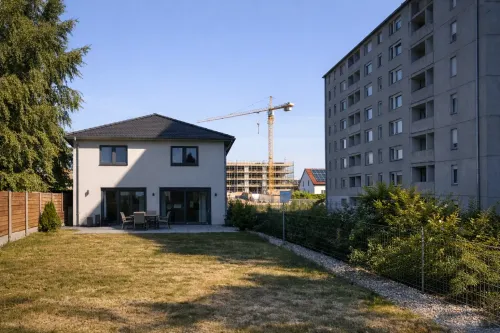
On the urban fringe and in suburban areas, background noise often drops because less traffic has to pass through the area. Many residential streets function more like local access roads, where most drivers actually have a destination in the neighborhood. As a result, suburban locations often feel more relaxed, especially at night. The most common surprise, however, is that suburban does not automatically mean quiet. Typical exceptions include feeder and collector roads, which bundle traffic from several smaller streets and can become the actual noise driver in the neighborhood; rail lines or expressways at the edge of the area, which can create recurring sound events even when the home feels green and residential; and park-and-ride sites, school zones, or sports facilities, which create peaks at specific times such as mornings, evenings, or weekends. This is exactly where the neighborhood context in the noise map is helpful: a suburban location can be very quiet overall, but one single axis can cut through the area, and that axis ends up deciding whether the specific address is truly low-noise.
- ✓ Scan suburban neighborhoods for collector roads: a single street can overturn the entire quiet profile.
- ✓ Think in time peaks as well: schools, sports, and park-and-ride areas often create recurring noise windows despite a generally quiet structure.
Living More Relaxedly: How Families Can Weigh Quiet, Outdoor Space, and Routes Realistically
For families, living "more relaxed" is rarely only about volume. It is about how daily routines work. Three factors are especially important. First, sleep and recovery: if children or parents sleep badly on a regular basis, everyday life quickly becomes exhausting no matter how practical the location is. Second, usable outdoor space: a balcony, courtyard, or nearby park only adds quality of life if you actually want to use it. In noise-shaped locations, outdoor areas are often used less, even when they objectively exist. Third, quiet routes: residential quality depends not just on the apartment but also on the routes to school, the playground, or the supermarket. A neighborhood can be quiet inside but still be cut through by loud axes, making routes less pleasant for children or for walking in general. If you are comparing the city center with the urban fringe, it helps to run a very practical family test: imagine a typical weekday with leaving in the morning, returning in the afternoon, and the evening routine. Then check whether the potentially quiet time windows, especially evening and night, are really protected in the noise profile and whether outdoor spaces can play a real role in everyday life without noise constantly accompanying them.
- ✓ Assess outdoor space as a quality factor: a balcony only counts if it is genuinely usable, and noise is a key factor in that.
- ✓ Check family routes too: not just whether the apartment is quiet, but whether routes to school and play areas are dominated by noisy axes.
The Classic Trade-Off: Suburban Quiet vs. Longer Commute Time, and How to Weigh It Fairly
The choice between quieter suburban living and city proximity is almost always a trade-off: more quiet and more open space versus longer travel times. The mistake is not having the trade-off. The mistake is underestimating it. A fair comparison works best through two separate questions. First: how much quiet do I really need, and at what times? If sleep and quiet in everyday life have very high priority, suburban quiet often has disproportionately high value. Second: what commute time is realistically sustainable, not just once but permanently? Commute time is not only about minutes but about daily energy use. Even though this article focuses on road noise, in practice it makes sense to consider the noise profile and the route profile together. A location is truly relaxing only if it protects quiet time and does not make everyday trips permanently draining. This is exactly where a standardized location report adds value: it lets you compare locations across identical modules without allowing one factor, such as quiet, to make another factor, such as routes, disappear from view.
- ✓ Document the trade-off explicitly: how much quiet do I gain versus how much commute time do I lose? Decide only after that.
- ✓ Define "relaxed" holistically: sleep, outdoor space, and routes, not just one axis such as quiet or proximity alone.
An On-Site Check That Actually Helps: Three Time Windows and Two Locations
To keep the city-versus-suburb comparison from remaining theoretical, a very pragmatic on-site check is worthwhile. It does not have to be long, but it should be smart. Use three time windows: evening, typically between 8 and 10 p.m., which shows leisure traffic, arrival patterns, and restaurant effects; early morning, typically between 6 and 7 a.m., which shows delivery traffic, the start of commuting, and garbage routes; and weekday daytime, depending on your use case, which matters for home office, seniors, or nap times. Then check two points per address: directly at the home, meaning window height, balcony level, or the entrance, which captures the immediate surroundings; and at the nearest axis that the map identifies as potentially burdened, which captures the neighborhood context. This links map interpretation with reality: the map gives you the hypothesis about where the axis lies, and the on-site check confirms how that actually feels in daily life. This combination is especially valuable because the report deliberately structures the noise profile as both immediate surroundings and neighborhood context.
- ✓ Test three time windows: evening, early morning, and weekday daytime. Most surprises show up there.
- ✓ Check two points per address: directly at the building and at the nearest axis from the map, so neighborhood quiet is tested in a real way.