Safe and Quiet: How Parents Can Find a Child-Friendly Neighborhood
A child-friendly neighborhood is not just "nice". It can be assessed in a structured way: low street noise, safe everyday routes, and an environment where families can feel comfortable for the long term. This article shows how parents can interpret street-noise maps and demographic or neighborhood data correctly, compare several residential areas objectively, and identify where children can sleep quietly and be outside safely.
12.03.2026
What "Child-Friendly" Really Means: Safety and Quiet as Location Factors
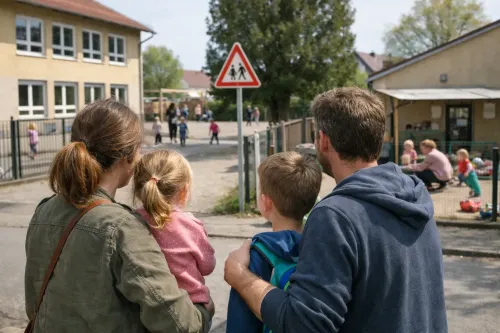
Parents often say they are looking for a child-friendly area. In practice, two very concrete location factors shape everyday life: safety, meaning whether children can use routes and outdoor spaces without fear, and quiet, meaning whether children can sleep, learn, and recover well. These factors are not purely subjective. They can be assessed much better with data than through a single viewing. The typical mistake in the search for a neighborhood is to derive safety and quiet from snapshots. A street may feel calm during a viewing even though it functions as a through route during peak hours. Or a neighborhood may seem family-oriented even though its demographic structure suggests more short-term turnover. An objective location analysis helps reduce these risks. It shows how street noise is distributed around the property and what the neighborhood profile looks like structurally. The right mindset matters here: data does not replace intuition, but it makes intuition testable. The goal is a neighborhood that works reliably for children, not just today, but for years.
Understanding Street Noise: Why Quiet Does Not Start at the Front Door, but Across the Neighborhood
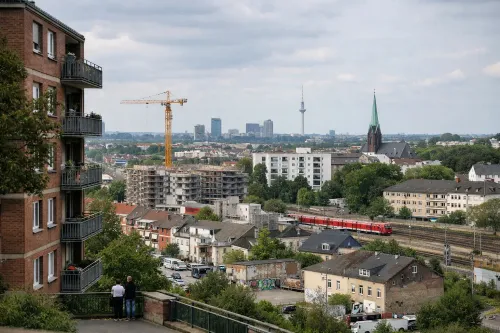
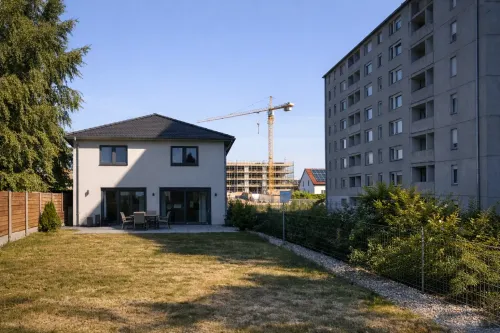
When many people think about a quiet location for children, they focus first on their own street. In reality, however, noise often acts as a neighborhood-level phenomenon. Major roads, intersections, feeder roads, or heavily used streets shape how much traffic noise spreads across the surrounding area. That is why a street-noise module with a map model is so valuable: it makes two levels visible. First, the immediate surroundings around the location. This is the level parents feel most directly, at the bedroom window, on the balcony, in the courtyard, and in play areas. Second, the wider neighborhood context. This is the level that affects everyday routes. Even if the apartment itself is quiet on the rear side, the neighborhood may still be shaped by noise corridors that affect children's routes and outdoor spaces. For families, this distinction is crucial. Children do not only sleep in the apartment, they live in the neighborhood. A location is truly quiet only when quiet is not just a building feature, such as soundproof windows, but a location pattern.
How Parents Should Read the Street-Noise Map Model Correctly
Street-noise map models visualize potential noise exposure based on factors such as road types, speed limits, and building information. For parents, the key is less about memorizing a single number and more about recognizing patterns and deriving concrete checks from them. A practical way to interpret the map is this. 1) Identify noise corridors. Look for continuous bands or zones with elevated exposure. These are often major roads, feeder routes, or traffic nodes. For a child-friendly neighborhood, what matters is whether these corridors dominate the immediate area or lie far enough away. 2) Pay attention to transitions. Often the main road itself is not the whole problem. The critical issue may be the transition into side streets through cut-through traffic, shortcuts, or access roads. If the map shows higher exposure flowing into side streets, that is a warning sign of unexpected traffic. 3) Evaluate immediate surroundings and neighborhood context separately. In the immediate surroundings, sleep and retreat matter most, including nighttime, naps, and home office needs. In the wider neighborhood, routes and stay quality matter, such as the way to the playground, the school route, and everyday errands. A child-friendly location should create as little conflict as possible on both levels. 4) Use the map as a viewing plan. Its greatest value is operational. The map tells you where to listen and where to go on site. Instead of vaguely checking how it feels, you deliberately assess the marked corridors, intersections, and transitions, and you do so at typical times such as morning, late afternoon, and evening. That turns a subjective impression into a structured check. It is especially useful when you want to compare several residential areas for child safety because you can assess every address using the same logic.
Quiet Locations for Children: What Parents Should Check Specifically for Sleep and Recovery
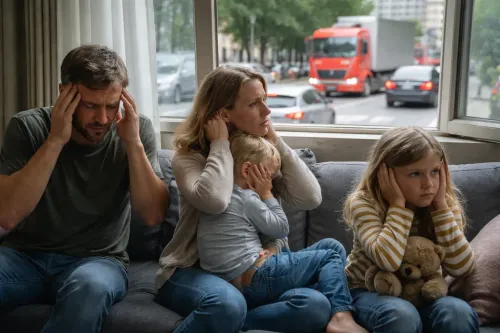
For children, noise is especially stressful when it is recurring and falls into periods of rest. That is why it helps to combine location data with a sleep-focused logic. Check evening and nighttime windows to see whether the location lies near corridors that are still heavily used after dark. Check early traffic as well, because many residential locations are pleasant during the day but become problematic in the early morning due to commuter traffic. Also look at retreat spaces. Even if a street is louder, an apartment with a quiet inner courtyard can still work very well, but only if that courtyard is truly quiet and usable. Data helps here by prompting the right questions. Where is the noise source? Is it a single corridor or a network? Is the problem directly in front of the building or across the neighborhood? From a parent's perspective, the key decision rule is this: the less you depend on structural compensation such as always keeping the windows closed, the more sustainable the quiet quality is. In practice, that means if the map model shows a clear burden nearby, the next question is not whether you can get used to it, but whether there is a robust solution that will still work two years from now. For families, robustness matters more than optimism.
Safety in the Neighborhood: What Demographic and Neighborhood Data Can Really Tell Parents
A safe neighborhood for families is a sensitive topic and at the same time a legitimate need. The important point is to understand demographic and neighborhood data correctly. They are not an individual judgment about people, but a structural profile of the residential environment. Parents can use them to derive clues about whether a neighborhood is more family-oriented, how stable the residential population appears to be, and which life stages dominate. In practice, several aspects can be helpful. 1) Age structure and household types. A higher share of family households or an age structure indicating many children and parents in the neighborhood is often a clue that the local infrastructure fits family life and that children are normal in everyday life, including playgrounds, school routes, and family-related offers. 2) Stability versus turnover. Neighborhoods differ in whether they are shaped more by short-term turnover, frequent moves, smaller households, and transitional living, or by more stable household structures. For families, stability can matter because it makes social networking easier. Parents are more likely to know one another, and children can find friends more easily in the immediate surroundings. 3) Socioeconomic structure as a planning indicator. Socioeconomic data, such as employment structure, income ranges, or household size depending on data availability, should not be read as a label, but as an indication of which housing products are in demand locally and how the neighborhood is developing. For parents, the practical use is this: does the neighborhood fit our life model, our needs, and a long-term residential perspective? The key is what you infer from it. Demographic data can help identify a family-friendly environment, but it does not replace the reality check. It helps you verify more specifically whether there are family-oriented amenities, children visible on everyday routes, and a clear everyday use of the area by families. When the data and the on-site impression fit together, decision confidence increases.
How Parents Can Combine Street Noise and Neighborhood Data into a Reliable Location Comparison
The strength of an objective analysis lies in the combination. Street noise says something about quiet quality and traffic dominance, while neighborhood data says something about the surrounding structure and how family-oriented the environment is. Together, they create a much more robust picture than any single factor alone. A useful comparison process looks like this. Step 1: use the noise profile as a knockout criterion. If a residential area is heavily shaped by noise corridors and shows hardly any quiet zones in the immediate surroundings, that is an exclusion criterion for many families regardless of how beautiful the property may be. Step 2: use family orientation as a fit check. If the noise profile is acceptable, then check the neighborhood profile. Is it plausible that children can be well integrated into everyday life here? Is there a structure that points to family routines, for example in the age mix or household types? Step 3: document the risk. If one location is weaker in one dimension, for example somewhat louder but strongly family-oriented, document consciously how you would compensate for that and whether the compensation is realistic. This logic prevents parents from getting lost in isolated arguments. It creates a clear and comparable decision basis across several neighborhoods.
The On-Site Check That Actually Helps: Use Data to Test the Right Things
Even the best data analysis does not replace an on-site check, but it makes it targeted. Once you have already reviewed street noise and neighborhood data, you can plan viewings in a way that reveals real risks. A practical plan is this: test two time windows, once in the morning during school and commuting time, and once later in the afternoon or early evening. Walk the noise corridors highlighted on the map. Where is the burden clearly noticeable? Is there cut-through traffic in side streets? Check retreat spaces such as the inner courtyard, play areas, and routes to the nearest green space, not just the front entrance. Simulate everyday life for a child. Where would the child walk or cycle? Are there safe crossings? Does the route feel plausible? Observe neighborhood signals as well. Are families visibly using the area? Are there children-related amenities and spaces where people spend time? The goal is not to measure everything perfectly, but to validate the most important location assumptions. For families, this is especially worthwhile because if sleep and safety do not fit, it is difficult to compensate for that in everyday life.
Decision Grid: Find a Child-Friendly Neighborhood in 10 Minutes per Address
To avoid chaos when comparing several residential areas, it helps to use a short grid that you fill out identically for every address. 1) Street noise in the immediate surroundings: are there quiet streets around the location or do corridors dominate? 2) Street noise in the neighborhood: does the address lie within a network of burdened streets or in a quieter context? 3) Sleep reality: are there plausible retreat spaces, such as an inner courtyard or rear-facing side, without the need for permanent compensation? 4) Neighborhood profile: does the environment appear family-oriented, with age structure and household types as indicators, and reasonably stable? 5) Risk note: what would be the biggest disadvantage of the location, and can it realistically be compensated for? This grid gives parents a traceable decision process. And that is the point. Searching for a child-friendly area does not mean finding a perfect location, but finding the location that works reliably for your own family.