How to Identify Surface Sealing: Why Land Use Matters So Much
Surface sealing in residential areas is an underestimated environmental factor. It affects heat, rainwater runoff, and long-term location quality. This article explains how to spot heavily sealed neighborhoods, how to read maps and indicators from the Relocheck land-use module, and which risks buyers and investors can derive from them.
12.03.2026
Surface sealing in residential areas: why this environmental factor measurably changes location quality
The phrase "surface sealing in residential areas" sounds technical, but it describes something very concrete: how strongly surfaces are covered by impermeable materials such as concrete or asphalt, meaning how little natural soil remains to absorb water and how little effective green surface remains in the immediate surroundings. For buyers and investors, this is not a side issue because sealing affects several dimensions of a location that can show up in everyday life and in demand. First, sealing affects the microclimate. Heavily sealed surfaces store heat and release it slowly. That can make summer periods feel far more uncomfortable than in similarly central but greener locations. In practice, you see this not only on the thermometer but in how usable outdoor areas remain: balconies, courtyards, sidewalks, and play areas become too hot more quickly, and quality of stay shifts indoors. Second, sealing affects rainwater absorption. The less water can seep into the ground, the more surface runoff forms during heavy rain. That is not alarmism but simple physical logic: impermeable surfaces divert water, and that can create local stress, such as overloaded drainage, water on traffic surfaces, or wet basement entrances. For investors, this is mainly a risk and cost question. A location profile with high sealing often requires closer attention during property review and operation, including drainage, outdoor areas, underground garage access, and backflow protection. Third, the level of sealing is a strong proxy for neighborhood character. Many sealed surfaces usually mean more traffic infrastructure, parking areas, dense urban fabric, or commercial influence. That may be desirable because of urbanity, proximity, or density, but it is still a clear environmental factor of the residential location and can therefore be compared. The practical benefit of a data-based representation is that sealing is hard to compare fairly by eye alone. A viewing creates impressions, but not comparability. That is exactly why land-use and sealing analyses are useful: they make the environmental quality of a location objectively visible and comparable across several properties.
How to recognize heavily sealed residential areas before a viewing
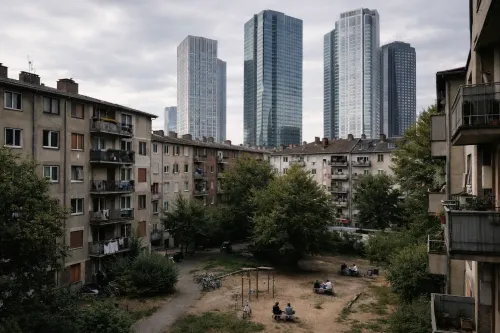
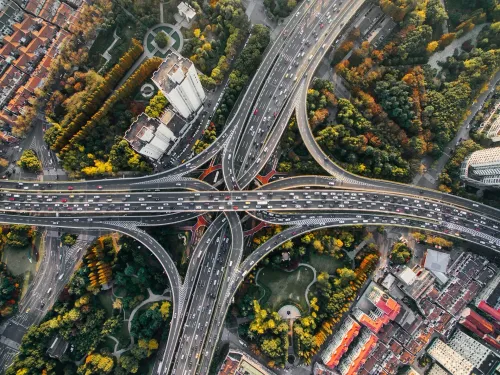
Even without a measuring device, heavily sealed districts can often be recognized by recurring patterns. These patterns are especially useful during the research phase when you want to pre-sort many locations quickly. Very few strips of greenery in the street space are one clue. If sidewalks, edge zones, and intermediate areas show hardly any vegetation, that points to a high level of sealing. Large parking areas and wide traffic surfaces are another clue because parking lots, large access roads, maneuvering zones, and broad street spaces significantly increase the impermeable share. Courtyards with no meaningful green component are another sign, because when courtyards are mostly paved and have little open soil or greenery, both water absorption and summer cooling decline. More generally, hard surfaces dominate the visual impression: asphalt, concrete, and paving shape the district, while trees appear only sporadically instead of across the area. For investors, the important point is that these visual characteristics are indicators, not metrics. Two neighborhoods can look similar while differing significantly in their sealing level, for example because of hidden surfaces such as back courtyards or operating areas, different block structures, or large sealed zones that are not immediately visible. That is why a land-use analysis is valuable as a complement. It does not replace a viewing, but it makes research more reliable because it quantifies visual impressions and makes them comparable.
How to read the surface-sealing map: from surface impression to environmental and risk indicators
The Relocheck land-use module uses a surface-sealing map as a central visualization. The core idea is simple: the map shows how strongly the surrounding surfaces are shaped by impermeable materials. That turns a gut feeling such as "it looks very built over" into a spatial profile. The most important interpretation logic is not the single point, but the pattern. First, broad, connected zones of high sealing. When large areas around the location appear heavily sealed, that usually indicates a hard neighborhood profile with more traffic, more built form, and fewer natural surfaces. This can shape both the summer climate and the quality of outdoor space and is therefore relevant for evaluating residential quality. Second, islands of lower sealing as relief spaces. Areas with lower sealing, such as parks, open land, waterside zones, or looser built form, often act as recovery and climate-relief zones. For end users, that means not only the home itself matters, but also whether you can quickly reach surroundings that feel less harsh. Third, transitions in the immediate area. If sealing is very high directly around the location but drops noticeably a few streets away, that can make a real difference in daily life, for example for walks, children’s routes, or perceived summer heat. It is important to remember that the map is an environmental and surface indicator, not a direct judgment on an individual building. It helps compare risks and location quality systematically, especially when several properties fall within the same price range and environmental factors are useful as a differentiator. The report also explains that high sealing restricts natural soil functions because the ground can absorb and filter less water. That causal logic is exactly what makes the map so relevant for investors: it links the location profile with possible follow-on effects such as heat, runoff, and environmental quality.
The distance metric: minimum distance to areas with low surface sealing as a quick location test
Alongside the map, one distance indicator is especially practical: the minimum distance to areas with low surface sealing. This value answers an everyday question: how quickly can I move from a heavily sealed environment into an area that tends to be more open, greener, or simply less harsh? For buyers, this is a comfort and quality-of-life indicator. If relief spaces are close, the likelihood of actually using them rises, whether for a short walk, short trips with children, or a quick cool-down in greener surroundings. For investors, it is also a resilience indicator. The report typically links proximity to lower sealing with lower building density. Depending on the micro-location, that can support rental appeal and demand because the location is not entirely dependent on a dense, highly sealed structure. The correct reading is important: distance is a quick filter, not a quality judgment. A less sealed area can be many things, such as a park, a waterside space, agricultural land, or a sports area. That is why the distance value should always be read together with the land-use map. Only the combination explains what this relief space actually is and how it can be used in daily life.
Land-use analysis: why sealing is often misread without land use
A common misinterpretation is that high sealing is bad and low sealing is good. It is not that simple, and that is exactly why land use in the same module matters so much. The land-use map categorizes areas by use type, for example urban fabric, commercial or industrial units, agricultural land, or water bodies. This provides the context that makes sealing interpretable in a meaningful way. Discontinuous urban fabric, for example, is described in the report as urban structures and traffic networks combined with vegetated areas and open surfaces, with a moderate typical share of impermeable features such as buildings, roads, and paved areas. In practice, that means urbanity with mixed components, not automatically a concrete desert, but often noticeably denser than loosely built edge locations. Industrial or commercial units are different because buildings, built structures, and artificial surfaces dominate. A sealing profile in that context has to be judged differently than in a pure residential quarter because the rhythm of use, traffic volumes, and outdoor-space logic are different. Agricultural land, pastures, or water bodies can show lower sealing because of more natural surfaces, which may be favorable climatically but also imply a different use logic, different accessibility, and different location dynamics. For investors, this context is decisive because risk arises not only from sealing but from the combination of surface and use. A dense, highly sealed urban area can have very strong demand but also higher summer stress and lower outdoor quality. A less sealed area can be climatically pleasant but come with different location drivers such as accessibility, local offer, or demand profile. In short, the neighborhood sealing level is an important environmental indicator, but land use is the interpretation tool that makes the conclusion sharper.
Green space as a counterweight: what green density contributes and where trade-offs arise
The report complements the sealing perspective with green-space visualizations. A green-space map shows the density of planted areas and makes visible whether greenery in the surroundings exists only in isolated pockets or across larger parts of the area. This is central for evaluating a residential location because green spaces and vegetation often act as a counterweight in sealed environments. They improve the quality of stay, provide recreation, and can positively influence the microclimate. At the same time, there are trade-offs that investors and buyers should know. A lot of tree cover can increase shading. The report notes that very dense tree cover in the immediate vicinity can cause problematic shade. That does not contradict the logic of greenery; it simply points to priorities. Anyone who strongly values daylight and sunny outdoor areas should read greenery not only as a plus but as a profile characteristic. Green on the map is also not automatically the same as green in everyday life. That is why distance values, both to green space and to low-sealing areas, are so useful: they increase the likelihood that greenery is actually reachable and usable. For investors, this means that a location profile with a high sealing level can gain significant attractiveness through nearby, well-distributed green spaces. Conversely, a location with lower sealing but no genuinely usable green space within walking distance may benefit less than expected. That is exactly why the combination of sealing, green space, and land use is so valuable in comparisons.
Risk logic for investors: what surface sealing can tell you about due diligence, rental appeal, and value
For investors, the key question is not simply whether the district is sealed, but which risks and opportunities arise from it and how they can be assessed efficiently. First, sharpen the property review in a targeted way. In heavily sealed surroundings, it is worth taking a close look at drainage, surface-water routing, underground garage access, courtyards and outdoor areas, as well as construction measures that keep water out or direct it away. Sealing is not direct damage, but it is a context that makes certain review areas more important. Second, summer comfort can be a demand factor. In warm summers, the quality of outdoor spaces such as balconies, courtyards, and nearby greenery can affect rental appeal. A high-sealing profile without nearby relief spaces may lead to discounts for some target groups, whereas strong access to green space can stabilize demand. Third, the location story becomes more objective. Brokers and landlords benefit from explaining environmental factors in a data-based way. Instead of vague statements such as "a lot of concrete," they can describe the location profile clearly: high, medium, or low sealing, relief spaces at what distance, and the density of green space in the surroundings. Fourth, the greatest advantage is comparability across a portfolio. If you compare several possible investments, a land-use module delivers identical metrics and visualizations for each location. That reduces the risk that the decision is driven by accidental impressions. The crucial point remains that surface sealing in residential areas is not a moral judgment, but an environmental and risk factor. Anyone who classifies it objectively can make better location decisions, both for owner-occupation and for investment.
Limits of the data: why the report delivers comparability, but validating critical points still makes sense
A data-based report is especially helpful when it is transparent about its limits. The report notes that despite high quality standards, the large amount of analyzed information means accuracy and completeness cannot be guaranteed in every case, and it recommends involving professional support for important decisions. In practice, that means you should use the sealing map, land use, and distance indicators as an objective basis for comparison and as a review plan. If a location makes the shortlist, a short and targeted on-site plausibility check is worthwhile. Where is rainwater likely to flow during heavy rain, looking at slopes, drainage channels, and courtyard access? How does the streetscape feel on warm days in terms of shade, trees, and airiness? Are relief spaces, meaning less sealed areas and green spaces, actually easy to access, or are they separated by barriers? This keeps the value of the data high. The data provide comparability, while the on-site review confirms the decision-relevant points without forcing you to judge every address purely by feeling.