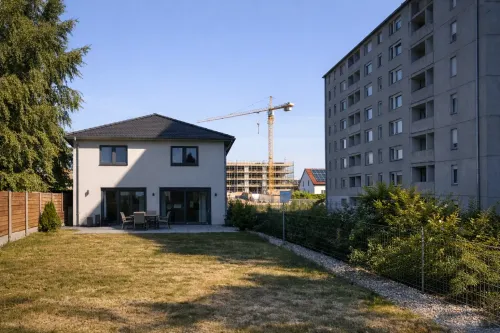
Location Analysis for Agents: Objective Site Rating Instead of Sales Cliches
"Prime location" hardly convinces anyone today, but solid location data does. This article shows how agents can build an objective location analysis and use road-noise, green-space, and land-use maps to deliver a transparent, understandable site assessment without exaggeration, but with substance.
12.03.2026
Why Sales Cliches Cost Trust, and Data Earns It Back
Many prospects have learned to translate standard phrases: a "quiet prime location" can in practice mean little traffic right in front of the building, but a busy through-road 150 meters away. These gaps between expectation and reality create questions, uncertainty, and in the worst case the feeling that something is being glossed over. This is exactly where an objective location analysis starts: it separates observable, measurable location factors from subjective impressions and makes statements verifiable. For agents, that brings two immediate advantages. First, you reduce room for interpretation. Instead of making a vague claim, you provide a traceable explanation: noise is higher near the street, but significantly lower in the courtyard area, as shown by the map and the surrounding context check. Second, you professionalize your advisory role. Anyone who can explain location quality in a structured way automatically positions themselves as an expert rather than just a seller. One point matters: objective does not mean cold. It simply means that you work with reliable information and communicate clearly what the data shows and what it does not. The tone can remain service-oriented: you help buyers, tenants, or investors weigh risks and advantages instead of steering them with superlatives.
How Professionals Build a Location Analysis: From the Question to a Verifiable Statement
A strong location analysis does not begin with maps but with a clear questioning logic. In practice, the following order works well: first the usage scenario, then the relevant location factors, then the data modules, then the interpretation, and finally on-site plausibility checks. The usage scenario comes first because an investor evaluates location differently from a family. For a family, quiet, green space, and everyday routes are often central, while investors focus more on demand resilience, rental appeal, and deal risks. Agents benefit when they make the scenario explicit: for this property, the micro-location is explained above all through quiet and green space; for capital investors, also through land-use structure and potential disturbance sources. Relevant location factors come next. Location quality is multi-dimensional. In a data-based location report, road noise, green space and biodiversity, surface sealing, and land use are presented as separate perspectives. The key is the separation: each factor answers a different question. Noise answers how quiet the place is likely to be. Green space answers how close to nature and restorative the surroundings are. Surface sealing and land use answer how dense, how urban, and how potentially heat-, water-, or disturbance-sensitive the area may be. Then you select the data modules. For a clear argument, choose a few core modules per property instead of explaining everything at once. The advantage of standardized reports is that the modules are comparable and repeatable. Then comes interpretation. Data only works if you explain it. That includes color scales, reference areas such as immediate surroundings versus neighborhood, and how the findings play out in everyday life. Finally comes plausibility. Serious analyses combine data with local observation. The right mindset is decisive here: data is not the truth in an absolute sense, but a strong, structured evidence base that you explain transparently and support with a short on-site check.
Understanding Road Noise: What the Map Model Shows, and How to Explain It Correctly
Road noise is one of the most common reasons why buyers walk away after a viewing, because its full effect is only really felt in daily life. The great value of noise maps is that they make visible in advance where higher noise levels are likely. In the report, road noise is presented as a map model that derives potential noise levels for an area from factors such as speed limits, road types, and building information. The result is a visual surface where louder axes and quieter zones can be identified. For interpreting this in everyday brokerage work, three points are central. First, the reference area. The report explicitly emphasizes that noise levels in the immediate surroundings matter, but that a broader context, the neighborhood, also helps explain road noise properly. This is extremely valuable in client conversations: a property can sit in a relatively quiet micro-position, for example facing a courtyard or side street, even if the wider neighborhood includes a louder main road. The opposite is also possible: a property may seem acceptable in the big picture but still sit on a locally noticeable edge. Second, reading maps means recognizing patterns, not single pixels. Explain to prospects that the map offers a model-based assessment. It highlights hotspots, such as major traffic arteries, and transitions, such as shielding effects from surrounding buildings. The goal is not to promise an exact decibel value but to make risks visible early. Third, translate the data into lived housing reality. Buyers and tenants think in situations: the bedroom at night, the balcony in the evening, the children's room during the day. Use the map to address these situations: the entrance side is in the quieter zone, the street frontage shows higher exposure, and during the viewing you can jointly check how the window positions and courtyard feel in reality. That is how data and lived reality are connected without dramatizing anything. This is what creates an objective location description: not a claim, but a transparent and verifiable conversation about the surroundings.
- ✓ Read the noise map first for main axes and quiet zones, meaning patterns, not single values.
- ✓ Separate immediate surroundings from the wider neighborhood and explain that difference in words.
- ✓ Use on-site plausibility checks at at least two times of day, for example rush hour and later in the evening.
Green Space and Biodiversity: What the Green Space Map Actually Tells You
Green surroundings are often described emotionally in listings: green setting, close to the park, and similar phrases. It becomes professional only when you separate two questions. First, how close is the nearest usable green space? Second, how green is the surrounding area overall? The report uses a green-space and biodiversity map for this purpose. It shows the density of vegetated areas in a region on a green color scale. This makes it possible to see at a glance where the surroundings are strongly shaped by vegetation and where there is comparatively little greenery. For client communication, the interpretation works in three levels. First, the distance to the nearest green space. This is the everyday-use indicator. The shorter the distance, the more likely the area is to be genuinely usable in daily life for walks, playground visits, or running. That matters especially for families, dog owners, and health-conscious buyers. Second, the amount of green space in the surroundings. This works more indirectly, but it is often even more important for overall residential feel and the microclimate. The report notes that the total amount of green space can influence the attractiveness of the surrounding area. As an agent, you can derive a factual statement from that: not only the nearest park matters, but the overall picture of the neighborhood. Third, tree cover as a special case. More trees do not automatically mean better. The report explicitly states that very high tree cover in immediate proximity can create problematic shade, so distance and tree height should also be considered. That is an important quality feature of your advisory work: you present the advantages, such as recreation value and possible cooling, while also naming possible trade-offs, such as less daylight, more leaves, or damper areas. This turns green into a serious location description: distance, density, and side effects, explained in plain language but based on data. For investors, green space is also a demand factor: residential locations with a noticeable environmental quality are often more stable to rent out. For owner-occupiers, it is a daily quality-of-life factor. Both can be explained objectively when you interpret the map, the distance logic, and neighborhood density in a clean way.
- ✓ Explain distance to the nearest green space as an everyday-use indicator, not as a mere nice-to-have.
- ✓ Mention green density across the neighborhood separately from simple park proximity.
- ✓ Always communicate tree cover as a possible shading factor as well.
Surface Sealing: Land Use as a Risk and Quality Indicator
Surface sealing is a location factor that rarely appears in a brochure, even though it says a great deal about neighborhood character and environmental quality. In the report, surface sealing is described as covering land with materials such as concrete or asphalt that make the ground impermeable. As a result, natural soil functions can be lost and water can be absorbed and filtered less effectively, which can negatively affect the environment and quality of life. What makes this especially valuable for agents is that sealing acts as a proxy for building density and surface character. The report adds that properties closer to areas with low surface sealing generally correspond to areas with lower building density. This helps create an objective classification without drifting into value judgments. When interpreting the surface-sealing map, you should explain two different logics clearly. First, the minimum distance to low-sealing areas. This is not a moral judgment of green versus gray, but a question of proximity to less densely built zones. For families, that can mean faster access to more open areas. For investors, it can signal neighborhood profile, such as urban densification versus a looser structure. Second, the amount or degree of sealing in the surroundings. The report clearly states that the level of sealing should be taken into account because it can influence the attractiveness of the environment. Here you can remain factual: high sealing often correlates with more traffic, fewer unsealed areas, and a more urban overall character. One additional and often overlooked point is the shading aspect. The report mentions that a very high degree of surface sealing in immediate proximity can also indicate problematic shading effects and reduced natural daylight, which is why the distance and height of surrounding buildings should be included in the assessment. For your advisory work, this is a strong argument for integrated interpretation: surface sealing is not only an environmental indicator, but also an indicator of building and daylight conditions. If you explain this logic well, you deliver a location analysis that feels serious because it makes rarely discussed but relevant factors understandable, and because it weighs benefits and potential drawbacks transparently.
- ✓ Explain surface sealing as an indicator of density and surface character, not as a moral judgment.
- ✓ Always mention both dimensions: distance to lower-sealing areas and the degree of sealing in the surroundings.
- ✓ Place possible daylight and shading effects from dense development into a clear, understandable context.
Land Use: Maps Create Context, and Context Creates a Solid Location Story
One of the biggest weaknesses of many location descriptions is the lack of context. Prospects hear words such as urban or up-and-coming, but they do not see how the surrounding area is actually used. This is exactly what a land-use map can provide in a structured way. In the report, land use is described as the categorization of land according to the activities that take place on it, such as residential, commercial, agricultural, or industrial use. For agents, land use is valuable because it delivers two things at once: it explains neighborhood character, such as living, mixed-use, or working, and it makes potential disturbance sources or opportunities visible without speculation. A practical approach is to take the most important land-use classes in the surroundings and translate them into what they mean for everyday life. The report describes classes such as discontinuous urban fabric, a mix of buildings, transport networks, and vegetated or bare areas with 30 to 80 percent impermeable features; industrial or commercial units, meaning areas dominated by buildings and artificial surfaces, sometimes with a bit of vegetation; complex cultivation patterns; water bodies; or pastures. The professional interpretation is not that industry is bad and greenery is good, but rather what implications are plausible. Commercial and industrial units can point to delivery traffic, operating hours, or a mixed-use setting. For some buyers, that is a risk; for others, such as those valuing short trips to work, it can be an advantage. Discontinuous urban fabric often explains exactly the locations that are hard to describe: not fully inner city, not purely green, but a patchwork of development, roads, and open spaces. Water bodies can mean recreational value, but also the need to pay attention to risks that should be checked in other modules, such as flood risk. If you explain land use in this way, you provide a location story that is not based on marketing language but on understandable environmental context. In advisory conversations, that is usually much more convincing than any slogan, because the client notices that you are not selling but explaining.
- ✓ Use land use as context to explain neighborhood character, not to label it.
- ✓ Stay neutral around commercial or industrial uses and mention plausible implications such as traffic or mixed use.
- ✓ For water bodies, point to additional review modules or documents, such as risk checks, without speculating.
Transparency and Liability: How to Use Data Strongly Without Overpromising
The more data-based your argumentation becomes, the more important the correct handling of limitations is. A serious report can do a great deal, but it does not replace every single-case review. The report says this explicitly: despite high quality standards, the accuracy and completeness of the data and the reliability of the models cannot be guaranteed because of the large volume of analyzed information; support from reputable agents and other professional advisers is therefore recommended in order to make sound decisions and avoid potential financial or legal problems. For agents, this is not a weakness but a professional framework. You use data in the same way other industries do: as an evidence-based decision foundation plus plausibility checks. Three wording principles help in brochures and advisory conversations. First, say shows rather than proves. A map shows patterns and indications; it does not prove every individual case. That makes your statements more robust. Second, say in context rather than in isolation. You combine modules. For example, high sealing plus land use with commercial units plus a noise map near a main axis creates a plausible urban character. Conversely, high green density plus lower sealing proximity can point to a more open environment. It is the combinations that persuade. Third, say verifiable rather than perfect. You explain how prospects can check the findings: a time-of-day check for noise, a sightline check for green-space or shade topics, and a neighborhood walk for land-use context. That strengthens trust. This is how location analysis becomes a quality feature of your service: you reduce uncertainty, structure information, and make your advisory work understandable without drifting into absolute promises.
Practice: A Short, Repeatable Location-Analysis Routine for Every Property
If location analysis is to become part of everyday work rather than a nice-to-have, it needs a routine that you can repeat for every property. Start with a compact data screening: the road-noise map for hotspots and quiet zones, the green-space map for density and distance, surface sealing as a density indicator, and land use for context. From this, formulate three to five neutral core statements that can stand in a brochure without sounding exaggerated. In the second step, translate these statements into relevance for the target group without inventing new facts. For families, for example, short distance to green space becomes an everyday explanation about play and movement options. For investors, it becomes a demand-side argument about residential quality. For owner-occupiers looking for quiet, the noise map becomes the basis for a conversation about bedrooms and balcony orientation. In the third step, make the statements verifiable. This is often the strongest lever for trust: you show how data can be checked against a short on-site routine instead of claiming that the data itself is the whole truth. This is exactly how an objective location assessment is created, one that feels modern and at the same time remains legally and communicatively clean. The result is clear: your brochures become sharper, your advisory work more structured, and your positioning more credible, not through promotion but through understandable location transparency.