Proximity to Parks and Property Value: Why a Green View Is Worth Gold
Proximity to parks is more than a lifestyle detail: it works as a measurable location advantage that is often reflected in demand, lettability, and price stability. This article explains why views of greenery and short walks to parks have such a strong effect for buyers and investors, which mechanisms drive that effect, recreation, microclimate, and everyday comfort, and how Relocheck visualizations such as the green-space map, distance to green space, land use, and soil sealing help identify and assess park locations objectively and realistically.
12.03.2026
Why Proximity to Parks Can Influence Price at All
When people talk about a good location, they often mean things that are noticeable in everyday life: being outside quickly, reducing stress, having space to walk, jog, or play without getting into a car every time. These everyday benefits are exactly what make park proximity and a view of greenery attractive for many target groups. For owner-occupiers, the benefit is direct: the home feels lighter, the end of the workday slows down more quickly, and families gain a flexible space for recreation. For investors, the same benefit often translates into more stable demand. If a location offers a clear advantage that is hard to copy, public green space, it often stays attractive through many market phases. In property economics, this effect is often described through hedonic pricing: homes consist of many attributes, size, condition, transport links, and location quality, and the market capitalizes individual advantages into the price. Proximity to parks is one such advantage because it does not just sound nice; it can be used regularly and has a noticeable impact on quality of life.
Green View vs. Proximity to Parks: Two Effects That Should Be Separated
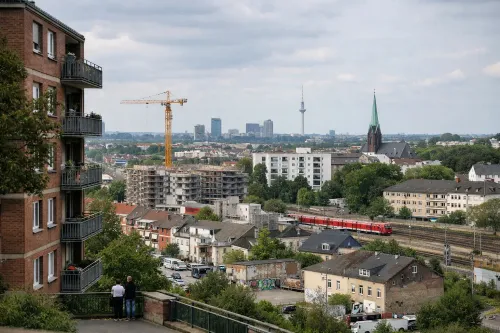
A view of greenery and a park around the corner are often thrown into the same basket, but they work differently. A green view is a visual comfort factor: it affects how spacious a room feels, the perceived sense of openness, and often the willingness to pay more, especially in smaller apartments or when working from home. A park within walking distance, by contrast, is a use factor: it creates real options, movement, play, routes, regardless of whether you can see greenery from the living-room window. For assessment, it is therefore worth asking a clear question: are you looking for green infrastructure that can be used every day, proximity to parks, visual quality, a green view, or both? Investors in particular benefit from not mixing these effects, because they can work differently across target groups.
Which Relocheck Visualizations Help Identify Park Locations Objectively
Park proximity can be captured surprisingly well with data, but only if several perspectives are combined. In the Relocheck report, four building blocks are especially useful. First, the metric minimum distance to the nearest green space: it is a hard indicator of how quickly you can actually reach greenery. That is a strong signal for everyday use, and therefore also for location attractiveness. Second, the amount of green area in the surroundings: it describes whether you are dealing with a single small green island or with an environment that is generally shaped by greenery. This matters because a single area can be pleasant, but an overall green environment is often perceived as significantly higher quality. Third, the green-space map: as a density map, it shows where greenery is concentrated, where it is distributed, and where larger green-poor zones lie. That makes neighborhood comparison possible without relying on the impressions of a single viewing. Fourth, land use and soil sealing: these contexts help explain whether greenery is embedded in an otherwise residential environment or whether the area is dominated by traffic, commercial use, or heavily sealed surfaces. That surrounding context is often decisive for price and demand effects.
Interpreting the Green-Space Map Correctly: What Investors Can Derive from Density
A green-space map is particularly useful because it does not only show park yes or no, but patterns. One pattern is green clusters: large, connected green zones, such as park systems or green corridors, are often strong and lasting location anchors. In many markets, such anchors remain value-relevant because they are hard to replace. A second pattern is distributed greenery: many smaller green spaces can be extremely practical in everyday life because they make short routes possible. For lettability, that can even matter more than one very large park that is impressive but effectively farther away. A third pattern is green-poor barriers: large, connected gray areas, sealing and traffic corridors, divide neighborhoods and can mean that the nearest park looks geographically close but is awkward to reach in everyday life. In practice, this means density maps should always be read with realistic accessibility in mind.
Distance to Green Space: How a Number Becomes a Realistic Demand Argument
Distance to the nearest green space is one of the easiest metrics to understand, especially for investors who want to compare location advantages systematically. For rentals, the rule often is: the shorter the distance, the greater the chance that tenants will perceive the advantage as a real feature. It turns there is a park in the district into I am in the park in a few minutes. That is a difference people feel in everyday life. For buyers, short routes increase not only actual use but often also the emotional bond with the location. That can help in a resale phase because the location is easier to describe without exaggeration, simply through clear everyday logic. Realistic interpretation remains important: a very short distance to green is not automatically a premium if, for example, the park sits on a loud main road or the green area is only a small strip. That is why distance should never stand alone, but should be read together with amount of greenery, green structure, and surrounding context.
Land Use and Soil Sealing: Why Proximity to Parks Works Differently in Gray Neighborhoods
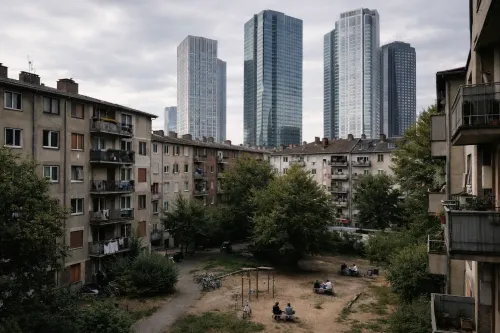
Proximity to parks can work especially strongly when the immediate surroundings otherwise offer little relief. In heavily sealed neighborhoods, a well-accessible park is often experienced as a contrast surface: out of asphalt and concrete, into shade, grass, and trees. This is exactly where land use and soil sealing add value from both the price and risk perspective. If the surroundings are heavily sealed, this can, depending on local climate and infrastructure, intensify comfort issues over time, heat stress, low quality of stay, and poor water infiltration. At the same time, a park within walking distance can become particularly valuable in such areas because it provides one of the few genuine location advantages. For investors, the key point is this: a location advantage becomes stronger the scarcer it is. If little greenery exists in a neighborhood, individual green anchors, parks or green corridors, can make a noticeable difference. Conversely, in already very green neighborhoods, the additional park effect can be smaller because greenery is present everywhere anyway. Correct interpretation comes from the interaction of the visualizations, not from a single number.
Risks and Side Effects: When Proximity to Parks Is Not Automatically Positive
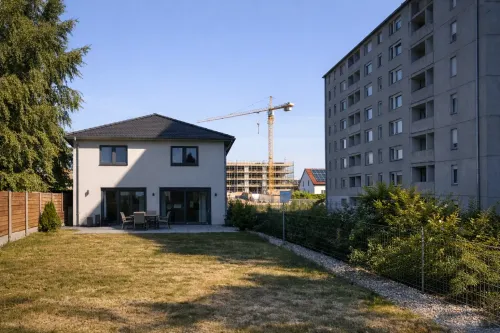
Proximity to parks is not a magic joker. There are situations where you need to look more closely, especially if you want to avoid selling yourself or others a story that is too pretty from an investor perspective. One point is intensity of use: some parks attract events, weekend traffic, or nighttime groups. That is not automatically bad, but it can be a disadvantage for some tenant profiles. This is where a reality check during viewings and at different times of day helps. A second point is shade: dense tree cover can improve the living climate, but when it is very close to windows it can also take away light. Fans of a green view may see that as a fair trade, while people with a high need for light may not. A third point is development risk: a green view is often less legally secure than proximity to a park. A park usually remains a park, but the view can change through new buildings or densification. Anyone using the view as the main argument should also check planning and development context. The good news is that exactly these trade-offs become easier when location indicators are compared in a standardized way and not only discovered after the purchase, when the advantage turns out to work differently in practice.
Practice: Evaluating Park Locations with a Comparison Setup for Buyers and Investors
If you are comparing two or more properties, a repeatable setup is worth gold. 1) Start with the green-space map: identify whether the address lies in an environment shaped by greenery or whether green appears only in isolated patches. 2) Distance to the nearest green space: translate the number into use, how likely is daily use? For families, that is especially decisive. 3) Amount of greenery in the surroundings: check whether greenery lies only on the edge or shapes the neighborhood overall. 4) Context through land use and soil sealing: ask whether the park is a bonus in an already residential environment or a compensating island in a heavily gray environment. Both can be attractive, but for different target groups. 5) Investor check: formulate the location quality without marketing clichés: X minutes to green space, high share of greenery in the surroundings, low soil sealing, or park as a rare relief in a sealed neighborhood, depending on what the data actually supports. That turns a view of greenery into a traceable location component that can be argued cleanly when choosing the property, letting it, and assessing its long-term value.